Tips and Tricks for the New Lifter

(A Blast from the Past article originally posted on 03/19/21)

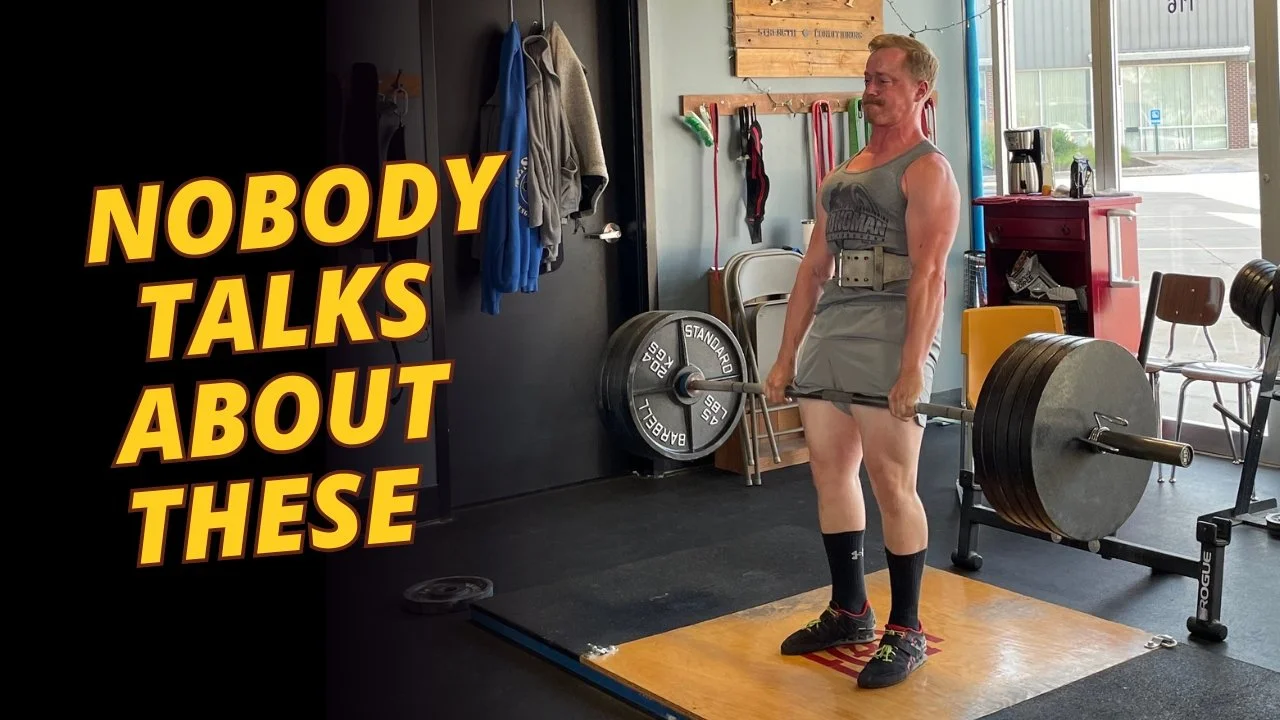
When you’re new to some task, like lifting, there are always a few tips and tricks that will seem rather obvious to you years later, so in an effort to speed things up a bit, here are several that might prove useful to both new and experienced lifters:

figure 1: An additional use for your wrist wraps

Deadlifting on a Non-level Floor
If you must deadlift on a slightly non-level floor (hopefully very slightly!), and you find that the barbell always wants to roll a bit, you can simply place your wrist wraps on the floor in front of the plates (Figure 1).

You can, of course, use any other soft, thin items like socks, lifting straps, even sponges, but don’t use a hard item like a 2.5-lb plate. If you set the bar down, and it glances off that item, it will come back at your shins, and shins and horizontally moving barbells don’t get along well (hint: the barbell always wins). In addition, the contact between the plate(s) on the bar and the 2.5-lb plate on the floor may cause one or both of them to chip. Wrist wraps are thick enough to immobilize the bar but soft and compressible enough that setting the bar down on top of the wrist wraps won’t cause any problems.

Quit Using 2.5-lb Plates . . . Sometimes
Stop using 2.5-lb plates in your warm-ups. As you get stronger, you’ll find that you can round most - if not all - of your warm-up weights to numbers that end in “5.” This will allow you to stop using 2.5-lb plates in your warm-ups.

If you’d like to use 2.5-lb plates in your final warm-up in an effort to be a bit more precise, that’s fine, but most of your warm-up weight selections won’t require this level of precision. (If your work sets on a given lift are less than 100 lbs, you might decide to use 2.5-lb plates more often in your warm-ups, but you can apply a similar exclusionary logic to the 1.25-lb plates instead.)

Stop Resting . . . Sort-of
Stop resting between your warm-ups sets. We mention this on a regular basis, but it still blows people’s minds that they don’t need to rest 5 minutes between every single set.

Do your empty bar sets (alright, you can rest 15 seconds between your two empty bar sets of five reps), then add weight and go. Then add weight and go again. Repeat until it’s time for your first work set, before which you should probably rest a few minutes. Remember - the act of changing the weight on the bar gives you enough rest to do the next warm-up set. This will save you a lot of time in the gym.

Write Out Your Next Workout
Write out your next workout before leaving the gym. As you gain experience, you may ditch this habit, and that’s perfectly fine, but when you’re new, it’s a very productive use of your rest periods to start writing out your next workout in your training journal - especially the warm-ups. You’re already in “training mode,” and the warm-ups you performed today will inform and influence the warm-ups you do next time, so now is as good a time as any to write out your next training session (and you won’t have to think too hard when you come in the gym next time).

As always, we hope these tips and tricks help you get stronger and live better.

-Phil

PS: Whenever you want even more Testify in your life, here are some free resources:

  • Book a free intro and strategy session with us HERE.

  • Pick up a free copy of Testify’s Squat Guide: 12 Tips to Improve Your Squat Now HERE.

  • Get our free weekly email - containing useful videos, articles, and training tips - HERE.

  • Follow Testify on Instagram HERE.

  • Subscribe to Testify’s YouTube channel HERE.

(Some links may be affiliate links. As an Amazon Associate, Testify earns from qualifying purchases.)


At Testify, we offer small group training, private coaching (in-person or remotely via Zoom), online coaching, and form checks. Interested in getting stronger, looking better, and having more energy?

book a free intro

Go Home, Get Weak, and DIE: Why Your Doctor is WRONG about Lifting Weights

You've heard it before: "Why are you doing this?" "You don't need to be lifting those heavy weights." And they're all wrong. So wrong.


At Testify, we offer small group training, private coaching (in-person or remotely via Zoom), online coaching, and form checks. Click the button below to get quality coaching from a Starting Strength Coach and start getting stronger TODAY.

Click here to start today

Testify Newsday - May 29, 2023

THIS WEEK'S QUESTION
From our video Do This for a BIGGER Squat! | How to Pause Squat (and Why!) (click the title to watch):

bebopdave
What proportion of 1RM would you do for paused squat?

Phil
Any percentages I throw out here would be very approximate as it will vary based on a few things. One factor would be the lifter’s experience with pause squatting. Someone new to pause squatting would have a bigger offset between the pause squat and the regular squat than a lifter who has trained the pause squat for a while. Also, a lifter who has a very efficient bounce out of the bottom of the squat will have a bigger offset between the two types of squats than a lifter who does not much of a bounce (i.e., a lifter who doesn’t get much of a bounce has a squat that already somewhat closely resembles a pause squat anyway :-))


ARTICLES & VIDEOS

How to INSTANTLY Squat More Weight!
Want to add pounds to your squat right away? Make sure you're utilizing the stretch reflex - the "bounce" - correctly. We show you how real quick-like. Click here to watch.

This Mistake Will RUIN All Your Lifts!
Want to improve every one of your lifts with one fix? Make sure you're doing this. Click here to watch.

The Best Way to Put On a Lifting Belt! (and a secret weapon)
We explain & demonstrate the best way to put on your lifting belt (and give you a super-secret weapon to use at meets!). Click here to read.

Blast from the Past: How to Start Lifting | General Equipment
What equipment do you need to start lifting weights and getting stronger? In this first video of the "How to Start Lifting" series, we cover the basic equipment that you'll nee (as well as what to avoid!). Click here to watch.

Blast from the Past: Mistakes New Lifters Make - Part III
We wrap up the "Mistakes New Lifters Make" series in Part III. Click here to read.


NEW TESTIFY GEAR!
Sun's out, guns out, and we've got men's and women’s tank tops in multiple colors. Get yours today and represent your favorite gym!

Click here to head to the Testify Store.


WHAT'S COMING UP
Update!
Parking will be restricted for roughly a week yet due to the curing process (as well as painting lines).

Reminder: In observance of Memorial Day (Monday, 05/29/23), we will be open for training during our usual morning hours (5:00 a.m. - 9:30 a.m.) that day, but we will be closed that afternoon and evening.

Below are a few of our upcoming events, and you can find out what else is on the calendar by heading to our events page at www.testifysc.com/events.

Testify Strongman Summer Showdown

  • June 17, 2023

  • Show up to lift, throw, carry, push, and pull big things, but most importantly, show up to have a great time with your fellow competitors and perhaps try something new!

  • Click here to register or for more information.

Testify IronFest V

  • July 8, 2023

  • IronFest is a team-based strength meet wherein the contested lifts will be the squat, press, bench press, and deadlift. Competitors will form teams of 2 lifters/team and perform all 4 lifts; each lifter will perform one upper body lift and one lower body lift, and each lifter will receive 3 attempts for each lift.

  • Click here to register or for more information.

Deadapalooza! The Annual Testify Deadlift Festival

  • August 25, 2023

  • Deadapalooza is a strength meet wherein the only contested lift is - you guessed it - the deadlift. There will be one bar (possibly multiple bars if numbers dictate), and the meet will be conducted in a "rising bar" format, so the weight on the bar only goes up! It's a ton of fun, so come on out!

  • Click here to register or for more information.


THIS WEEK’S CONDITIONING

Option 1
Sled
Outdoors:
10-20 x 25 yds EMOM at a weight of your choice

Every minute, push the sled 25 yards, i.e., if pushing the sled takes 20 seconds, then you have 40 seconds to rest. Perform 10-20 rounds.

Indoors:
10-20 x 100 ft EMOM at a weight of your choice

Every minute, push the sled 100 feet, i.e., if pushing the sled takes 20 seconds, then you have 40 seconds to rest. Perform 10-20 rounds.

Compare to 2023.03.27.

Option 2
Bike/row:
5 min on
4 min off
4 min on
3 min off
3 min on
2 min off
2 min on
1 min off
1 min on

Record distance for each interval and add for total distance.

Compare to 2023.03.06.

Option 3
5-10 rounds of:
30 sec ME tire flips
30 sec rest

Compare to 2023.02.06.

Option 4
Sandbag-over-bars
Set yoke at #33 for women or #35 for men.
1. 1 minute AMRAP
2. 5 rounds of 2 reps every 2 minutes (speed!)
3. 1 minute AMRAP

Weights
Female under 40 years
140 lbs and under: 75 lbs
140.1 lbs – 185 lbs: 100 lbs
185.1 lbs and over: 150 lbs

Female 40 years and over
140 lbs and under: 50 lbs
185 lbs and under: 75 lbs
185.1 lbs and over: 100 lbs

Male under 40 years
185 lbs and under: 150 lbs
185.1 lbs – 235 lbs: 200 lbs
235.1 lbs and over: 250 lbs

Male 40 years and over
185 lbs and under: 100 lbs
185.1 lbs – 235 lbs: 150 lbs
235.1 lbs and over: 200 lbs

Compare to 2023.02.06.

This Mistake Will RUIN All Your Lifts!

Want to improve every one of your lifts with one fix? Make sure you're doing this.


At Testify, we offer small group training, private coaching (in-person or remotely via Zoom), online coaching, and form checks. Click the button below to get quality coaching from a Starting Strength Coach and start getting stronger TODAY.

Click here to start today

The Best Way to Put On a Lifting Belt! (and a secret weapon)

A lifting belt is an extremely useful tool for your strength training, and within a month or two of starting to train, you should be using one regularly. Putting on a lifting belt, however, can be a bit tricky, so let’s sort this out.

How to Do It
There is one way - that’s right, just one - to put on a belt correctly, and it involves the upright of your squat rack. The photos here show a double-prong belt in use, but the method works just as well for single prong belts (in fact, it’s slightly easier). The steps are below, and to learn it even quicker and better, watch the included video.

  1. Put the nose of your belt through the buckle and wrap the nose of the belt around the upright.

  2. Lean away from the upright. Be sure to lean away so that your hips move away from the rack as well (Figure 1); don’t lean away like you’re trying to avoid a punch (Figure 2).

  3. Twist your body away from the rack. For example, if the nose of the belt came around the right side of your body, twist to your left (Figure 3). This will tighten up the belt.

  4. Put the prong(s) through the appropriate hole(s).

Taking off the belt is much the same as putting it on - wrap the nose around the rack, lean away, twist to loosen, and then remove the prong(s).

Squat Stands vs Squat Racks
If you have a squat stand (free-standing, two uprights) instead of a squat rack (anchored to the floor, four uprights), it may tip toward you when you lean away. This is bad. However, it’s an easy problem to solve. Simply place your foot down on the far side of the floor support, and you’ll be able to keep the squat stand anchored in place.

Secret Weapon
I told you there’s only one way to put on a belt, and this is true . . . mostly. If you’re at a meet, you might not have a squat rack handy when you’re about to step on the competition platform. Oh, you’ll have plenty of racks in the warm-up room, but there will quite possibly be none near the competition platform. Here’s what you do (and again, watch the video above to see this in action):

  1. Put the nose of your belt through the buckle.

  2. Place the pointed end of a screwdriver through one of the holes of the belt (Figure 4).

  3. Grab that end of the screwdriver (don’t impale yourself), and pull back, treating the screwdriver as a lever (Figure 5). This will get the belt as tight as you like.

How Tight Should Your Belt Be?
When you’re new to wearing a lifting belt, it should be uncomfortably tight. If it’s comfortable to wear and easy to wiggle around, it’s merely a fashion accessory. Don’t let your belt be a fashion accessory. With practice, what was uncomfortably tight at the beginning will simply feel correct.

Need to Buy a Belt? Watch This First.
If you’re getting ready to buy a lifting belt, I’d recommend watching the included video here to get a good sense of what to look for when purchasing one. You’ll also find some links below to a few belts we recommend to our members.

Belts
My belt is from Best Belts, and I’d love to recommend them to you, but as of May 2023, they're backlogged and aren't taking orders, so with that in mind, here are a few belt options we often recommend:

(Some links may be affiliate links. As an Amazon Associate, Testify earns from qualifying purchases.)

As always, we hope this helps you get stronger and live better.

-Phil

PS: Whenever you want even more Testify in your life, here are some free resources:

  • Book a free intro and strategy session with us HERE.

  • Pick up a free copy of Testify’s Squat Guide: 12 Tips to Improve Your Squat Now HERE.

  • Get our free weekly email - containing useful videos, articles, and training tips - HERE.

  • Follow Testify on Instagram HERE.

  • Subscribe to Testify’s YouTube channel HERE.

(Some links may be affiliate links. As an Amazon Associate, Testify earns from qualifying purchases.)


At Testify, we offer small group training, private coaching (in-person or remotely via Zoom), online coaching, and form checks. Interested in getting stronger, looking better, and having more energy?

book a free intro

How to Start Lifting | General Equipment

What equipment do you need to start lifting weights and getting stronger? In this first video of the "How to Start Lifting" series, Phil covers the basic equipment that you'll need, and he also covers what equipment to avoid as well.

(This video is a Blast from the Past video originally published on 10/04/21.)


At Testify, we offer small group training, private coaching (in-person or remotely via Zoom), online coaching, and form checks. Click the button below to get quality coaching from a Starting Strength Coach and start getting stronger TODAY.

Click here to start today