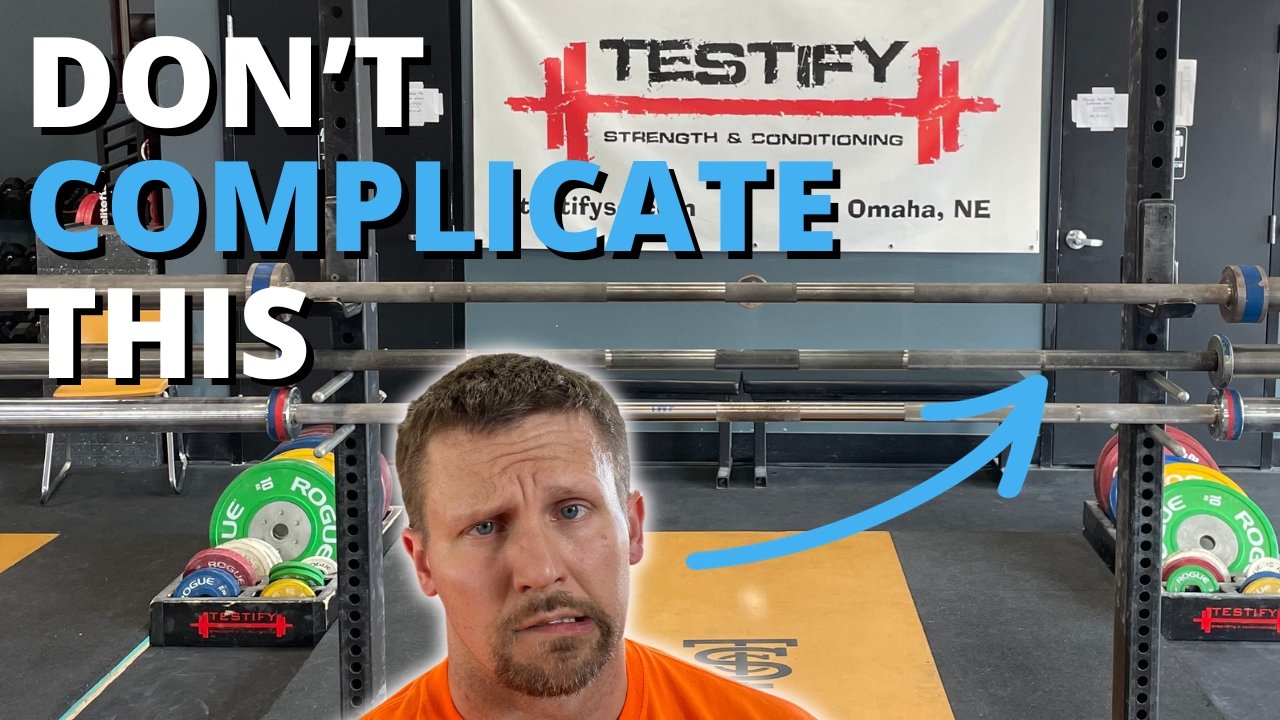
Barbell Rings - What Are These Things For?!

(This is a Blast from the Past article originally posted on 08/27/21.)

Every barbell has one or two pairs of rings - also known as score marks or knurl marks. Today, we’re going to talk about the two types of rings, the purpose of the rings, and how they might pose a problem for a new or inexperienced lifter.

For further explanation and demonstration of the topics covered in this article, be sure to check out any of the included videos.

From top to bottom - barbells with (A) power rings only, (B) weightlifting and powerlifting rings, and (C) weightlifting rings only

From top to bottom - barbells with (A) power rings only, (B) weightlifting and powerlifting rings, and (C) weightlifting rings only

The 2 Types of Rings
Using a dual-ringed bar (i.e., a bar with both sets of rings) for reference, the inner rings are known as the powerlifting rings or simply the power rings, and these marks are 81 cm apart (approximately 32 in). The outer rings are known as the weightlifting rings or the olympic rings, and these marks are 91 cm apart (approximately 36 in).

Purpose
Both sets of rings are used for reference points when you take your grip on the bar. In the sport of powerlifting, the power rings on a dedicated powerlifting barbell (or “power bar”) represent the maximum legal grip width for the bench press (i.e., at the widest legal grip, the index fingers still need to be in contact with the rings). In lifts other than the bench press (e.g., the squat) the rings still serve as a reference point upon which to base your grip.

In the sport of weightlifting - i.e., the snatch and clean-and-jerk - due to the wider grip widths used in the clean, the jerk, and specifically the snatch, it is useful to have a wider set of rings for reference, and thus, the weightlifting rings are set a bit wider than the power rings.

The Problem
A potential problem arises when a lifter switches from one barbell to a different barbell. Suppose, for example, that Jack is accustomed to training on a bar that only has one set of rings, and then he travels somewhere and ends up using a dual-ringed bar. Suddenly, Jack’s not sure which set he should be using for his reference point for his grip. 

Conversely, let’s say Jill has been training with a dual-ringed bar, and then she goes to her first competition, and the competition bar only has one set of rings. As Jill steps onto the competition platform, she isn’t sure whether she’s looking at the power rings or the weightlifting rings.

The solution here is pretty simple - know your equipment. If you’re not sure which rings you’ve been using, you can easily figure it out. If it’s a dual-ringed bar, you hopefully already know whether you’ve been using the inner set or outer set, and if it's a single-ringed bar, break out your tape measure and check the distance between the rings (32 inches = powerlifting rings and 36 inches = weightlifting rings).

If you have to go train or compete on a different bar, know the following points:

  • At a powerlifting meet, you’ll either encounter a power bar (i.e., a bar with power rings) or a bar with both sets of rings (less common at a meet).

  • At a weightlifting meet, you’ll either encounter a weightlifting bar (i.e., a bar with weightlifting rings) or a bar with both sets of rings (again, less common at a meet).

  • In general training, if you encounter a single-ringed bar, you’re probably - probably - looking at the power rings as these bars are far more common than dedicated weightlifting bars.

  • While the above points are useful, your best bet is to still measure.

Knowing these facts, you can keep your technique reproducible and therefore consistent wherever you go. 

As always, we hope this helps you get stronger and live better.

-Phil

PS: Whenever you want even more Testify in your life, here are some free resources:

  • Follow Testify on Instagram HERE.

  • Subscribe to Testify’s YouTube channel HERE.

  • Book a free intro and strategy session with us HERE.

  • Pick up a free copy of Testify’s Squat Guide: 12 Tips to Improve Your Squat Now HERE.

  • Get our free weekly email - containing useful videos, articles, and training tips - HERE.

(Some links may be affiliate links. As an Amazon Associate, Testify earns from qualifying purchases.)


At Testify, we offer small group training, private coaching (in-person or remotely via Zoom), online coaching, and form checks. Interested in getting stronger, looking better, and having more energy?

book a free intro

How to Build Pulling Blocks | Easy DIY Deadlift Blocks

Need some easy-to-make pulling blocks for deficit deadlifts, block pulls, benching, or even a makeshift deadlift platform? We've got you covered.


At Testify, we offer small group training, private coaching (in-person or remotely via Zoom), online coaching, and form checks. Click the button below to get quality coaching from a Starting Strength Coach and start getting stronger TODAY.

Click here to start today

Testify Free Press - September 25, 2023

THIS WEEK'S SUBMISSION
From our video Is Your Squat Stuck? It's Not Why You Think. (click the title to watch):

Mcluhan Salem
Coach what can happen if I lift my chest? To be sure I'm not doing it

Phil
To be clear, you will lift your chest eventually - after all, we finish the squat in a standing up, vertical position. The key is that you don't want to raise your chest too soon, which is why the cue "stay in your lean" works well. If you maintain your back angle for about the first half to two-thirds of the ascent, you'll be in good shape.

If you raise your chest too soon, you'll note that the squat slows down, is harder than it should be, and depending on the severity of the error, your knees might actually move forward when you start raising your chest.

Mcluhan Salem
Thank you

Phil
You’re welcome.


ARTICLES & VIDEOS

BEST Strategy for a Stronger, Smoother Deadlift (6 Simple Tips)
Trying to grip it and rip it? Don't be silly. You're missing out on a better deadlift and bigger PRs. Let's fix this. Click here to watch.


What His Poor, Sad Bench Press Was Missing
Far too many lifters don't use their legs effectively when they bench press. Do you? Find out and fix it in 2 minutes. Click here to watch.


Why Your Press is WEAK: Fix Your Unrack and Grip with this Simple Mnemonic Device
Struggling with the press? Phil gives you a simple mnemonic device to help you fix your unrack and your grip - it'll pay big dividends. Click here to read.


Blast from the Past: The Best Way to Put On a Lifting Belt! (and a secret weapon!)
Phil shows the best way to put on your belt and also talks about what to do at lifting competitions when this method might not be possible. Click here to watch.


Blast from the Past: Wrist Wraps: What, Why, When, and How!
We cover the basics of wrist wraps - what they are, why you use them, when to use them, and how to use them. Click here to read.


NEW TESTIFY GEAR!
Baseball season is here, and so is Testify’s new 3/4 raglan shirt - in multiple colors! Get yours today and represent your favorite gym!

Click here to head to the Testify Store.


WHAT'S COMING UP

Below are a few of our upcoming events, and you can find out what else is on the calendar by heading to our events page at www.testifysc.com/events.

Testify Fall Classic

  • October 21, 2023

  • The Testify Fall Classic is back for 2023, and we invite you to be a part of it! This is a strengthlifting meet, which means the contested lifts will be the squat, press, and deadlift.

  • Click here to register or for more information.

Free Intro to Squat Session

  • October 28, 2023

  • Are you interested in getting stronger? Book your free "Intro to Squat" session and learn to squat, meet some of our coaches, and see the gym! All ages and abilities are welcome.

  • Click here to book your free session.

Benching Bonanza! The Annual Testify Bench Press Jubilee

  • November 17, 2023

  • Benching Bonanza is a strength meet wherein the only contested lift is - you guessed it - the bench press. There will be one bar, and the meet will be conducted in a "rising bar" format, so the weight on the bar only goes up! It'll be a ton of fun, so come on out!

  • Click here to register or for more information.


THIS WEEK’S CONDITIONING

Option 1
Sled
Outdoors:
10 rounds of:
Push sled 100 ft
Pull sled 100 ft (hand over hand)

Indoors:
20 rounds of:
Push sled 50 ft
Pull sled 50 ft (hand over hand)

Compare to 2023.07.24.

Option 2
Bike/row:
4 x 3 minutes

Rest 3 minutes between each round. Score = lowest distance.

Compare to 2023.07.03.

Option 3
Outdoors:
5-10 rounds:
10 sledgehammer strikes (5R, 5L)
50 yd farmer carry (25 yd down-back)
Rest 1 minute

Indoors:
5-10 rounds:
10 sledgehammer strikes (5R, 5L)
100 ft farmer carry (50 ft down-back)
Rest 1 minute

Compare to 2023.06.05.

Option 4
1. 5 yoke carries @ 30 yd (15 yd downback) – work up to heaviest carry
2. 5 rounds of 5 reps on the axle “clean and press away” – work up to heavy set of 5

Compare to 2023.06.05.

What His Poor, Sad Bench Press Was Missing

Far too many lifters don't use their legs effectively when they bench press. Do you? Find out and fix it in 2 minutes.


At Testify, we offer small group training, private coaching (in-person or remotely via Zoom), online coaching, and form checks. Click the button below to get quality coaching from a Starting Strength Coach and start getting stronger TODAY.

Click here to start today

Why Your Press is WEAK: Fix Your Unrack and Grip with this Simple Mnemonic Device

A common problem in the press is a terrible unracking process, and we've covered this before in both videos and articles, but here’s a different take - a simple mnemonic device - that just might help you out.

The Problem
You know you want a neutral wrist when pressing. It shouldn’t be completely straight (although we might use the overcue “straight wrists” at times), but it certainly should not be bent backward in full extension, either. The problem of full extension is the more common of the two errors and is the situation we’re addressing here. For a video demonstration and explanation of this problem as well as how to solve it, be sure to watch one of the included videos.

When It Happens
You’re setting up to take your grip for the press - your grip is relatively narrow, you’ve pronated your hands slightly, and although you know you’re supposed to maintain a rigid, neutral wrist position as you approach and unrack the bar, it’s at this point that everything goes in the crapper. Somehow, as you approached the bar, you allowed your wrists to bend backward into full extension - which is a very weak and inefficient position from which to press - and now your coach wants to gouge his eyes out. Let’s prevent this.

The Culprit
You simply didn’t get low enough to allow yourself to maintain a neutral wrist. Remember that the legs are responsible for unracking the bar correctly - in a manner of speaking, you pick it up with your legs, not your arms. You need to dip down low enough so that you can keep your wrists neutral when approaching and unracking the bar. A decent pair of wrist wraps can help maintain neutral wrists, but they won’t cover up the root problem of not dipping down low enough with your legs.

A Simple Mnemonic Device
“Chest to bar, chin to bar.”

When taking your pronated grip, be sure to squeeze the bar tightly - crush the bar, if you will - then walk your chest up to the bar with your feet directly under the bar. This “chest to bar” aspect ensures you are close enough to the bar. Next, squat down - you’re actually just bending your knees - until the underside of your chin touches the bar.

By doing this, you’ve dipped down far enough that you’ve given yourself sufficient room to maintain a neutral wrist. If you don’t dip down far enough to create that space, your wrists will have to bend backward into extension to allow you to pick up the bar (because bending your wrists backward makes your forearms artificially shorter), and this is what you’re trying to avoid.

That’s all there is to it - simply walk your chest up to the bar, dip down until your chin touches the bar as you rotate your elbows slightly in front of the bar, and then stand the bar up while maintaining that nice, neutral wrist.

As a side note, some people won’t need to dip that far down; “chin to bar” will be overkill in these cases, but it will still work for pretty much everyone.

As always, we hope this helps you get stronger and live better.

(Some links may be affiliate links. As an Amazon Associate, Testify earns from qualifying purchases.)

If you found this helpful, you’ll love our weekly email. It’s got useful videos, articles, and training tips just like the one in this article. Sign up below, and of course, if you don’t love it, you can unsubscribe at any time.


At Testify, we offer small group training, private coaching (in-person or remotely via Zoom), online coaching, and form checks. Would you like to get quality coaching from a Starting Strength Coach?

click here to start today

The Best Way to Put On a Lifting Belt! (and a secret weapon!)

Phil explains and demonstrates the best way to put on your lifting belt and also talks about what to do at powerlifting and strengthlifting competitions when this method might not be possible.

(This is a Blast from the Past video originally published on 01/15/22.)


At Testify, we offer small group training, private coaching (in-person or remotely via Zoom), online coaching, and form checks. Click the button below to get quality coaching from a Starting Strength Coach and start getting stronger TODAY.

Click here to start today