Wrist Wraps: What, Why, When, and How!

(This is a Blast from the Past article originally posted on 07/09/21.)

If you’re new to lifting, you might have seen these things called wrist wraps, but you might not be sure what purpose they actually serve, so let’s chat.

What are wrist wraps?

Wrist wrap pair.JPG

Your basic wrist wrap consists of a thumb loop at one end, the elastic body of the wrap, and a hook-and-loop closure system (i.e., Velcro). Countless manufacturers sell wrist wraps with this basic structure - some common ones include Harbinger, SBD, Rogue, Schiek, and the list goes on. A very popular length of wrap is 18”, but you can find plenty of wraps that are both shorter or longer than this (longer is fine, but for most lifters, I wouldn’t recommend anything shorter than 18”). Some manufacturers (e.g., SBD) also make variations of their wraps that are either more rigid or more flexible depending on the lifter’s preference.

Why might I use wrist wraps?

You use wrists wraps when your wrists are in compression, i.e., when you’re pushing on something - not when you’re pulling on something. A wrap gives support to your wrist by acting as an external skeleton for your wrist - you can think of it as a cast or a lifting belt for your wrist. Since the wrap is wrapped around your wrist, it lends support to your wrist and makes it very difficult for the wrist to be in positions of extreme extension (i.e., positions where you wrist is bent very far backward). Lifts that benefit from wrists wraps include all the pressing movements (press, bench press, close grip bench, etc.), snatches, jerks, cleans (this is a gray area as you need your wrists to be in extension to rack a clean), and the squat for those who wrap their thumbs around the bar and have their wrists in extension. Even if you don’t normally use a wrist wrap, it’s probably a good idea to use one if you are dealing with and training through a wrist injury.

When might I use wrist wraps?

A reasonable approach is to treat your wrist wraps the same way you treat your belt - put the wraps on for your last warm-up set, and then use them for all of your work sets as well. With some experience under your belt (under your wraps?), you may decide to put them on earlier than your last warm-up, and that’s fine as well.

How do I use wrist wraps?
(Your best bet is to watch one of the videos included in this article, but the steps are listed below, and you can reference the photo sequence at the end of this article).

  1. Place your thumb through the thumb loop so that the wrap drapes over the back of your wrist.

  2. Position the body of the wrap so that it lies half on your forearm and half on your hand.

  3. Apply tension and wrap the length of the wrap around your wrist until you reach the end of the wrap.

  4. Close off the wrap by attaching it to itself using the Velcro strap.

  5. Remove the thumb loop from your thumb (it is simply there to keep the wrap from spinning in place while you apply the wrap, so you no longer need it).

A wrist wrap worn too low on the arm . . . don’t do this.

A wrist wrap worn too low on the arm . . . don’t do this.

Remember: this is not a forearm wrap or a hand wrap - it’s a wrist wrap, so be sure to pay attention to Step 2. If you position the wrap too low, it’s simply a forearm warmer, and if it’s too high, it’s just a weird glove. In effect, the wrap should almost lock those two sections of your arm together (i.e., the forearm and the hand), and to do so, it has to straddle both sections of your arm. If you put the wrap on correctly, it will make it harder to extend your wrist (i.e., bend it backwards), which means the wrap is doing its job of support.
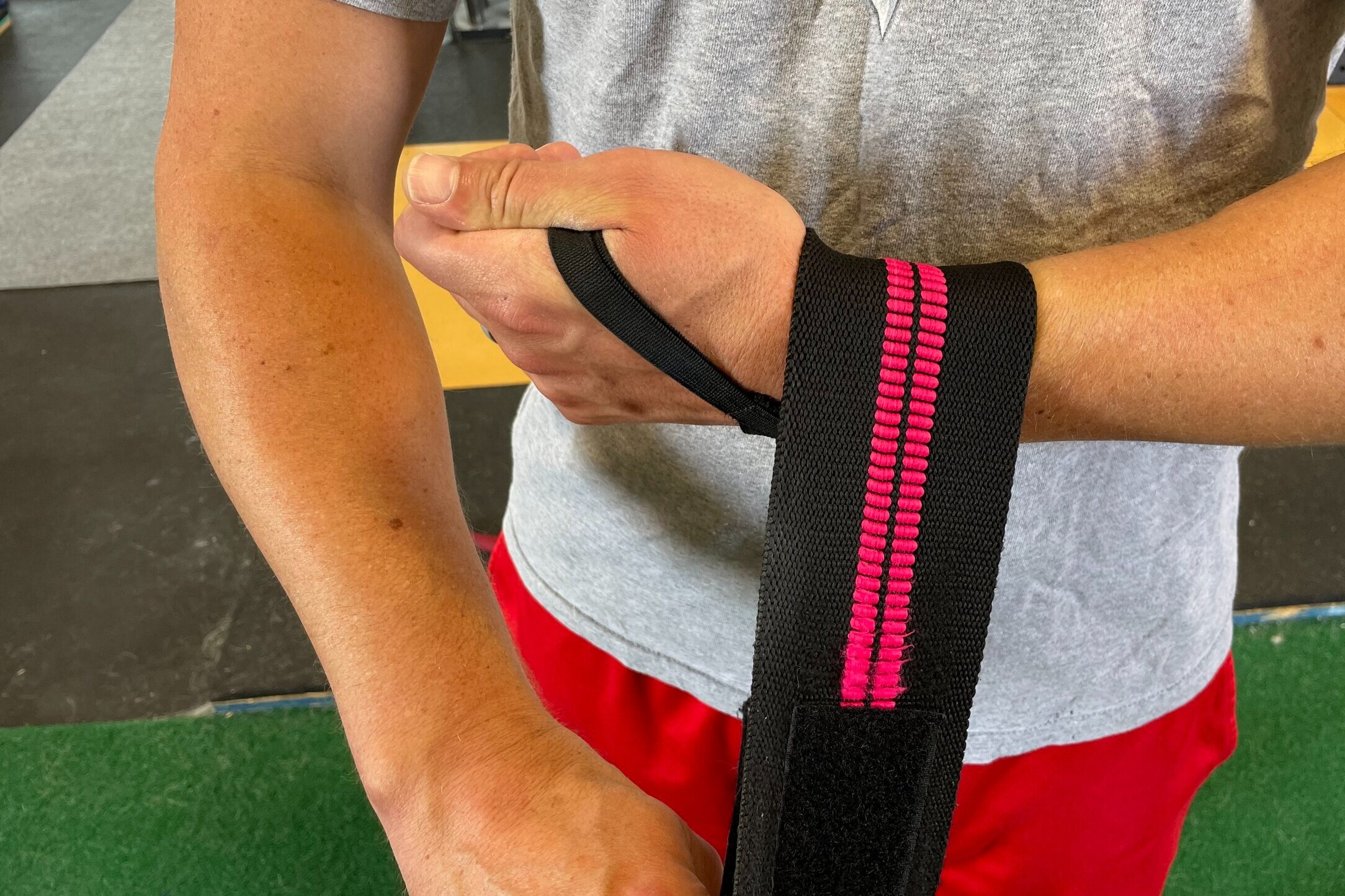
Quick re-wrap solution - pinch the thumb loop between your thumb and index finger and use that setup to anchor the beginning of the wrap in place while you re-tighten the wrap.

Quick re-wrap solution - pinch the thumb loop between your thumb and index finger and use that setup to anchor the beginning of the wrap in place while you re-tighten the wrap.

The wrap should be very snug - not so tight that you start losing circulation in your hand, but pretty darn tight. It needs to be tight so it can provide support. You will always loosen or perhaps even remove the wraps between sets. If you only loosen the wrap between sets, you don’t need to re-insert your thumb in the thumb loop - a quicker solution is to simply pinch the thumb loop between your thumb and index finger and use that setup to anchor the beginning of the wrap in place while you re-tighten the wrap.

That pretty much wraps it up!

(Some links may be affiliate links. As an Amazon Associate, Testify earns from qualifying purchases.)

If you found this helpful, you’ll love our weekly email. It’s got useful videos, articles, and training tips just like the one in this article. Sign up below, and of course, if you don’t love it, you can unsubscribe at any time.


At Testify, we offer small group training, private coaching (in-person or remotely via Zoom), online coaching, and form checks. Click the button below to get quality coaching from a Starting Strength Coach and start getting stronger TODAY.

click here to start today
Step 1: Place your thumb through the thumb loop so that the wrap drapes over the back of your wrist.
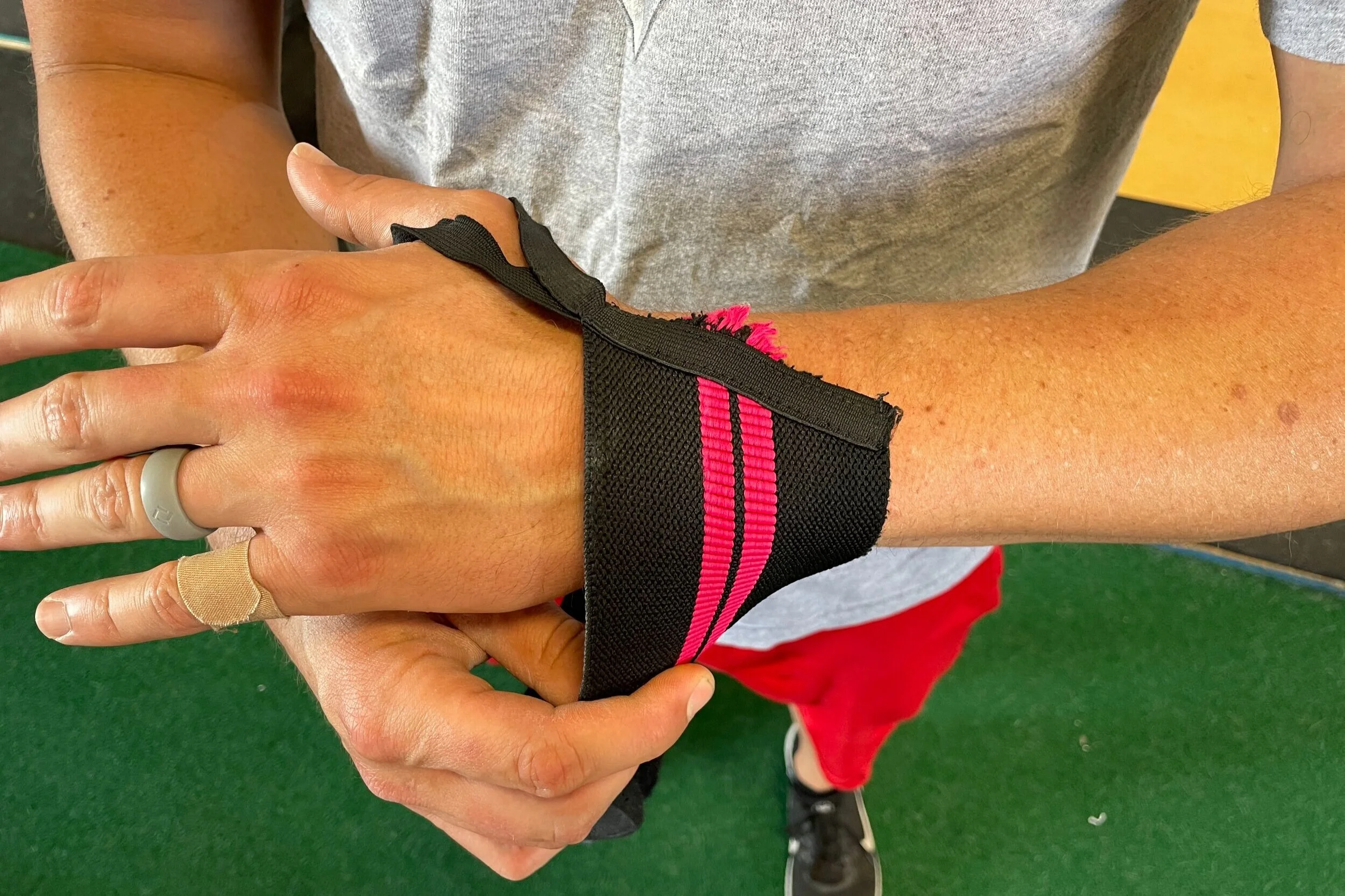
Step 1: Place your thumb through the thumb loop so that the wrap drapes over the back of your wrist.

Step 2: Position the body of the wrap so that it lies half on your forearm and half on your hand.

Step 2: Position the body of the wrap so that it lies half on your forearm and half on your hand.

Step 3: Apply tension and wrap the length of the wrap around your wrist until you reach the end of the wrap.

Step 3: Apply tension and wrap the length of the wrap around your wrist until you reach the end of the wrap.

Step 4: Close off the wrap by attaching it to itself using the Velcro strap.

Step 4: Close off the wrap by attaching it to itself using the Velcro strap.

Step 5: Remove the thumb loop from your thumb (it is simply there to keep the wrap from spinning in place while you apply the wrap, so you no longer need it).
Step 5: Remove the thumb loop from your thumb (it is simply there to keep the wrap from spinning in place while you apply the wrap, so you no longer need it).

BEST Strategy for a Stronger, Smoother Deadlift (6 Simple Tips)

Trying to grip it and rip it? Don't be silly. You're missing out on a better deadlift and bigger PRs. Let's fix this.


At Testify, we offer small group training, private coaching (in-person or remotely via Zoom), online coaching, and form checks. Click the button below to get quality coaching from a Starting Strength Coach and start getting stronger TODAY.

Click here to start today

Testify Star - September 18, 2023

THIS WEEK'S SUBMISSION
From our video Bench Pressing Alone (safely!) and How to Unrack a Heavy Bench Press (click the title to watch):

lw216316
Don't be so hard on Milo, he was getting a pen to take notes as a good student should, so how much can Milo bench? I expect a lot since he has twice as many limbs to work with.

What about using a Smith machine instead?

Phil
We haven’t tested his 1 RM recently – we’ll have to work on that :-) As for a Smith machine, I would not recommend using that for benching (or squatting) as it makes one follow an artificial bar path, and this is often very conducive to causing shoulder problems.

lw216316
Thank you, I will try the method you show and see how it goes, go Milo!

Phil
You’re welcome, and I hope it works well for you!


ARTICLES & VIDEOS

5 Mistakes That DESTROY Your Lifting Warm-up
Want to have a more effective and efficient warm-up? Avoid these mistakes. Click here to watch.


Is Your Squat Stuck? It's Not Why You Think.
Does your squat have a weird sticking point, and you just can't figure it out? Let's fix it fast. Click here to watch.


Deadlift: The Next Rep is Going to be VERY Different
In the deadlift, a unique phenomenon occurs on the 2nd rep. Phil explains what happens, why it happens, and how you can take advantage of it. Click here to read.


Blast from the Past: How to Convert Kilograms to Pounds Fast | Easy Math Trick!
Convert kilograms to pounds quickly and easily without a calculator! Useful for physics homework, chemistry homework, and lifting weights. Click here to watch.


Blast from the Past: The Deadlift Dry-heaves . . . Don't Get 'Em!
Are you that guy (or girl) who looks like he's dry-heaving when setting up to pull? Cut it out! Phil helps you fix this problem. Click here to read.


NEW TESTIFY GEAR!
Baseball season is here, and so is Testify’s new 3/4 raglan shirt - in multiple colors! Get yours today and represent your favorite gym!

Click here to head to the Testify Store.


WHAT'S COMING UP

Below are a few of our upcoming events, and you can find out what else is on the calendar by heading to our events page at www.testifysc.com/events.

Starting Strength Self-Sufficient Lifter Camp

  • September 23, 2023

  • Spend the day learning the Squat, Press, and Deadlift and how to self-evaluate your lifts while training in your garage or commercial gym without a coach.

  • Click here to register or for more information.

Testify Fall Classic

  • October 21, 2023

  • The Testify Fall Classic is back for 2023, and we invite you to be a part of it! This is a strengthlifting meet, which means the contested lifts will be the squat, press, and deadlift.

  • Click here to register or for more information.

Benching Bonanza! The Annual Testify Bench Press Jubilee

  • November 17, 2023

  • Benching Bonanza is a strength meet wherein the only contested lift is - you guessed it - the bench press. There will be one bar, and the meet will be conducted in a "rising bar" format, so the weight on the bar only goes up! It'll be a ton of fun, so come on out!

  • Click here to register or for more information.


THIS WEEK’S CONDITIONING

Option 1
Sled Pyramid – 4, 5, or 6 tiers
Go up and down a 4, 5, or 6 tier “sled pyramid” – rest as needed. The distance for each round is 80 m indoors (a down-back on the 40m course) or 200 ft outdoors (2 down-backs on the 50 ft course). Rest as needed.

For example, Bob does the following (4 tiers):
Round 1: Empty sled
Round 2: 25#
Round 3: 50#
Round 4: 75#
Round 5: 50#
Round 6: 25#
Round 7: Empty sled

Compare to 2023.07.17.

Option 2
Bike/row:
5 min on
4 min off
4 min on
3 min off
3 min on
2 min off
2 min on
1 min off
1 min on

Record distance for each interval and add for total distance.

Compare to 2023.06.26.

Option 3
5-10 rounds of:
30 sec ME tire flips
30 sec rest

Compare to 2023.05.29.

Option 4
Sandbag-over-bars
Set yoke at #33 for women or #35 for men.
1. 1 minute AMRAP
2. 5 rounds of 2 reps every 2 minutes (speed!)
3. 1 minute AMRAP

Weights
Female under 40 years
140 lbs and under: 75 lbs
140.1 lbs – 185 lbs: 100 lbs
185.1 lbs and over: 150 lbs

Female 40 years and over
140 lbs and under: 50 lbs
185 lbs and under: 75 lbs
185.1 lbs and over: 100 lbs

Male under 40 years
185 lbs and under: 150 lbs
185.1 lbs – 235 lbs: 200 lbs
235.1 lbs and over: 250 lbs

Male 40 years and over
185 lbs and under: 100 lbs
185.1 lbs – 235 lbs: 150 lbs
235.1 lbs and over: 200 lbs

Compare to 2023.05.29.

Is Your Squat Stuck? It's Not Why You Think.

Does your squat have a weird sticking point, and you just can't figure it out? Let's fix it fast.


At Testify, we offer small group training, private coaching (in-person or remotely via Zoom), online coaching, and form checks. Click the button below to get quality coaching from a Starting Strength Coach and start getting stronger TODAY.

Click here to start today

Deadlift: The Next Rep is Going to be VERY Different

The Phenomenon
You’re sweaty, nervous - heck, practically nauseous at this point - and you are entirely unsure whether your upcoming set of five on the deadlift is going to go or not. So what do you do?

“Feelings lie,” you remind yourself, so you walk up to the bar, set up, and start the set.

The first rep is rough. Very rough. Rough like that single ply toilet paper you thought wouldn’t be so bad . . . but it was.

And then something interesting happens . . . the second rep is actually easier. Quite noticeably. You break it off the floor smoothly, and it certainly moves faster than the previous rep.

The third rep is about the same as the second rep, and the fourth and fifth reps are pretty tough, but by now, you know you can finish the set, and indeed you do.

What on earth? Why does the second rep go better than the first rep? And how can you take advantage of this phenomenon in the future.

Why This Happens
While there might be more than one reason, one probable factor is that - by the time you get to the second rep - your body “knows” how hard you have to pull to get that bar moving.

Among the Big Four - the squat, deadlift, press, and bench press - the deadlift is unique. It is the only lift of the four wherein you don’t support the weight of the bar before the lift starts. After all, it’s sitting on the floor. In the squat, press, and bench, you are supporting the bar before any movement starts, and as a result, you get to feel the weight of the bar compressing you before the real work begins. This gives your brain and body an opportunity to calibrate itself for the task ahead; it gives you a rough sense of how hard you have to drive the bar upward.

This isn’t true in the deadlift. That very first rep - the first time you struggle to break the weight off the floor - that is the actual opportunity for this so-called calibration. As a result, there are two activities going on in the first rep - you are getting a sense of the bar’s weight while at the same time completing a rep.

By the time you get to the second rep, you know - whether consciously or subconsciously - how hard you have to pull, and as it turns out, this helps quite a bit.

How Can You Use This Phenomenon to Your Advantage?
Get the first rep.

No, it’s not complicated or sexy, but it’s crucial. Don’t think about whether or not you’ll get all five reps. Don’t think about how tough the set is going to be. You know that - as long as you complete the first rep - the second rep will be easier, so . . .

Get the first rep. This is what you tell yourself. Get the first rep, and the rest of the set will take care of itself. It’s too easy to go down the rabbit hole of anxiety before starting a work set of deadlifts, so cut that process off at the pass. Remind yourself to complete the first rep, and then take it from there.

As always, we hope this helps you get stronger and live better.

If you found this helpful, you’ll love our weekly email. It’s got useful videos, articles, and training tips just like the one in this article. Sign up below, and of course, if you don’t love it, you can unsubscribe at any time.


At Testify, we offer small group training, private coaching (in-person or remotely via Zoom), online coaching, and form checks. Would you like to get quality coaching from a Starting Strength Coach?

click here to start today

How to Convert Kilograms to Pounds Fast | Easy Math Trick!

Convert kilograms to pounds quickly and easily without a calculator! Useful for physics homework, chemistry homework, and lifting weights.

(This is a Blast from the Past video originally published on 01/08/22.)


At Testify, we offer small group training, private coaching (in-person or remotely via Zoom), online coaching, and form checks. Click the button below to get quality coaching from a Starting Strength Coach and start getting stronger TODAY.

Click here to start today