
Week 2022.10.03
/New on the Testify YouTube channel!
This Week’s Conditioning
Option 1
”Prowler Base+1”
1. Load up a manageable weight.
2. Sprint 40m at 85% intensity.
3. Rest 30 sec.
4. Repeat 5-15 times.
Courtesy of “Death by Prowler” (on Starting Strength).
Compare to 2022.08.01.
Option 2
Bike/row:
4 x 800m
Rest 3 minutes between each round. Score = slowest time.
Compare to 2022.07.11.
Option 3
Outdoors:
10 rounds:
25 yd yoke carry
Rest 1 minute
Indoors:
10 rounds:
30 yd yoke carry (15 yd down-back)
Rest 1 minute
Compare to 2022.06.13.
Option 4
10 x 50 ft farmer carry
Each carry is 25 ft down and 25 ft back and is for time. Rest 1 minute between carries.
Women: 97# per handle (80# of plates)
Men: 137# per handle (120# of plates)
(Note: Each handle weighs 17#.)
Compare to 2022.06.13.
Wraps and Straps and Gloves, Oh My!
/
You’re a lifter, so of course, you’ve got to accessorize. But with all the options for lifting gear and accessories out there, what’s useful and what’s garbage? This article is the first in a short series covering exactly that, and today’s topic is gear associated with your grip.
Lifting Straps
Also known simply as “straps” or sometimes “wrist straps” (which is inaccurate), straps are useful for pulling movements, such as deadlifts, rows, and even snatches. Do NOT use them for cleans, and it’s worth pointing out they are actually worn on the hand and not the wrist itself.
They save some wear and tear on the hands, and if you’ve got multiple sets on the deadlift, then a reasonable approach is to use your usual grip for the first set (hook grip or alternate grip) and then use straps for the remaining sets.
You can buy straps or make them (quite cheaply!), and we’ve got a few videos covering how to make them as well as use them.
Wrist Wraps
These are useful for pressing movements such as the press, bench press, close grip bench press, etc. Wrist wraps provide stability for the wrist by acting as a sort of belt or cast for the wrist. When the weights get challenging, a good approach is to warm up (mostly) without wrist wraps and then put your wraps on (tightly!) for your last warm up as well as your work sets.
Not surprisingly, we have a few videos covering this topic as well.
Gloves
Nope. Don’t use ‘em. They add something squishy and deformable between your hand and the bar, which is never good for force transfer. Also, because they add a layer between your hand and the bar, they effectively make the bar diameter larger, which makes it harder to keep your grip when pulling the bar off the floor with deadlifts, rows, etc.
Lifting gloves are stupid. I know this firsthand because I have worn them in a previous life. Don’t use them.
Ahem, we do not have a video on this topic.
Chalk
We’ll save this discussion for another day, but suffice to say chalk is very important for your grip. Use chalk.
As always, we hope this helps you get stronger and live better.
(Some links may be affiliate links. As an Amazon Associate, Testify earns from qualifying purchases.)
If you found this helpful, you’ll love our weekly email. It’s got useful videos, articles, and training tips just like the one in this article. Sign up below, and of course, if you don’t love it, you can unsubscribe at any time.
At Testify, we offer small group training, private coaching (in-person or remotely via Zoom), online coaching, and form checks. Would you like to get quality coaching from a Starting Strength Coach?
Week 2022.09.26
/New on the Testify YouTube channel!
This Week’s Conditioning
Option 1
“Prowler Base”
1. Load up a manageable weight.
2. Sprint 40m at 85% intensity.
3. Rest until breathing and heart rate slow down. (45 sec – 2 min)
4. Repeat 5-15 times.
Courtesy of “Death by Prowler” (on Starting Strength).
Compare to 2022.07.25.
Option 2
Bike/row:
4 x 3 minutes
Rest 3 minutes between each round. Score = lowest distance.
Compare to 2022.07.04.
Option 3
Outdoors:
5-10 rounds:
10 sledgehammer strikes (5R, 5L)
50 yd farmer carry (25 yd down-back)
Rest 1 minute
Indoors:
5-10 rounds:
10 sledgehammer strikes (5R, 5L)
100 ft farmer carry (50 ft down-back)
Rest 1 minute
Compare to 2022.06.06.
Option 4
10 x 50 ft yoke carry
Each carry is 25 feet down and 25 feet back and is for time. Rest 1 minute between carries.
Compare to 2022.06.06.
How to Use Lifting Straps
/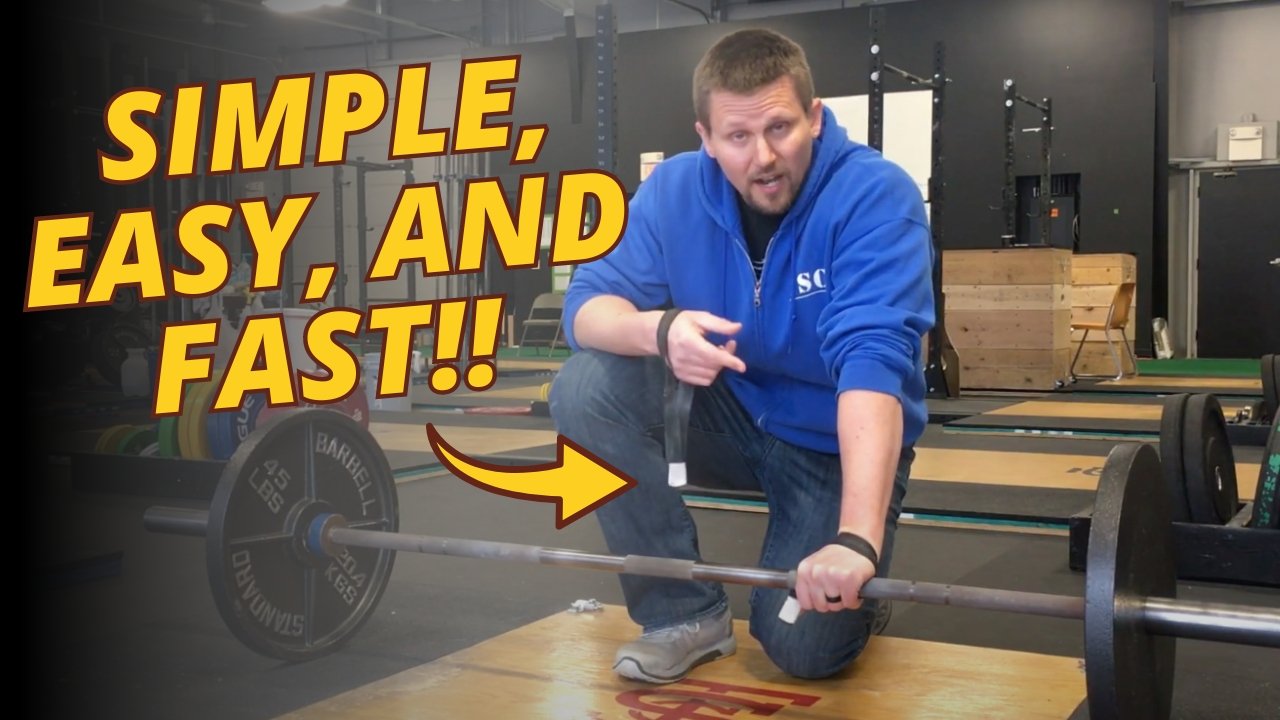
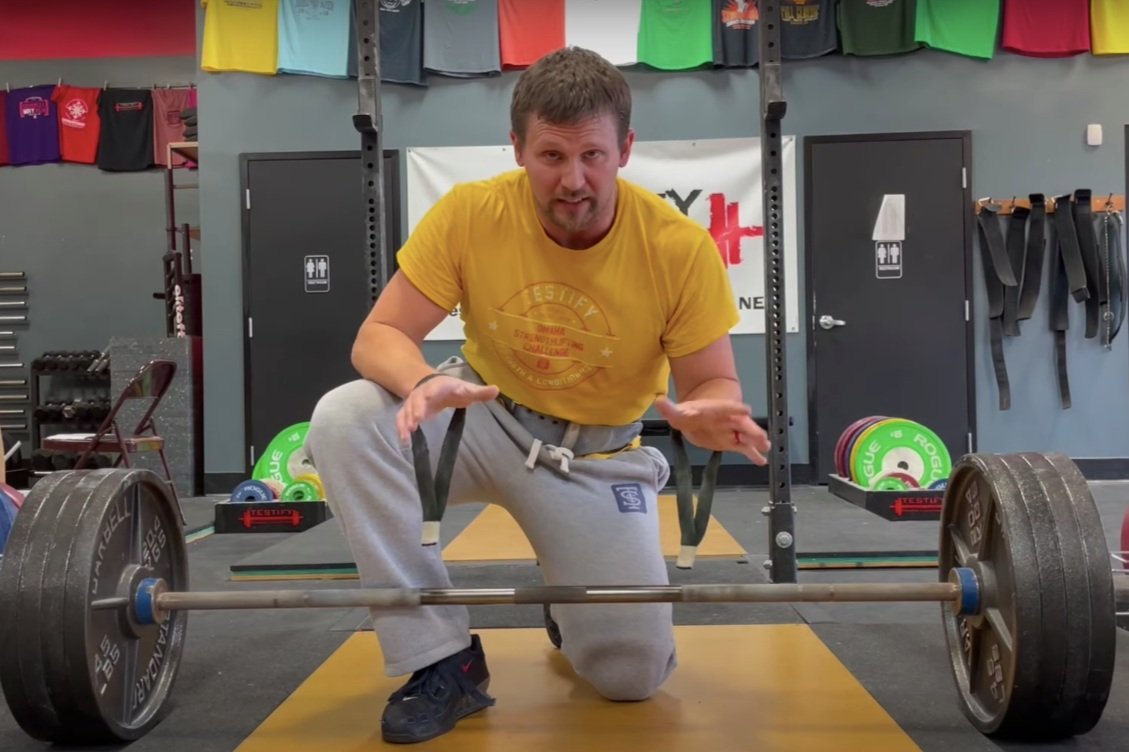
In a past article and a couple of videos, we’ve covered how to quickly and cheaply make yourself a pair of durable lifting straps. Today, let’s cover how to use them.
As is often the case, this process is best understood when you can see it, so I’d recommend watching one of the included videos.
Step 1
Place the straps over both hands. The threads face up, and the smooth side of the straps (the side without the threads) should face forward.
This step assumes you’re using the type of DIY straps we make in this video (or a similar commercial design). If you’re using the “loop-and-cinch” style of strap such as this pair, you can move on to step 2, but make sure that your straps are oriented in the correct direction (click here to see a demonstration).
Step 2
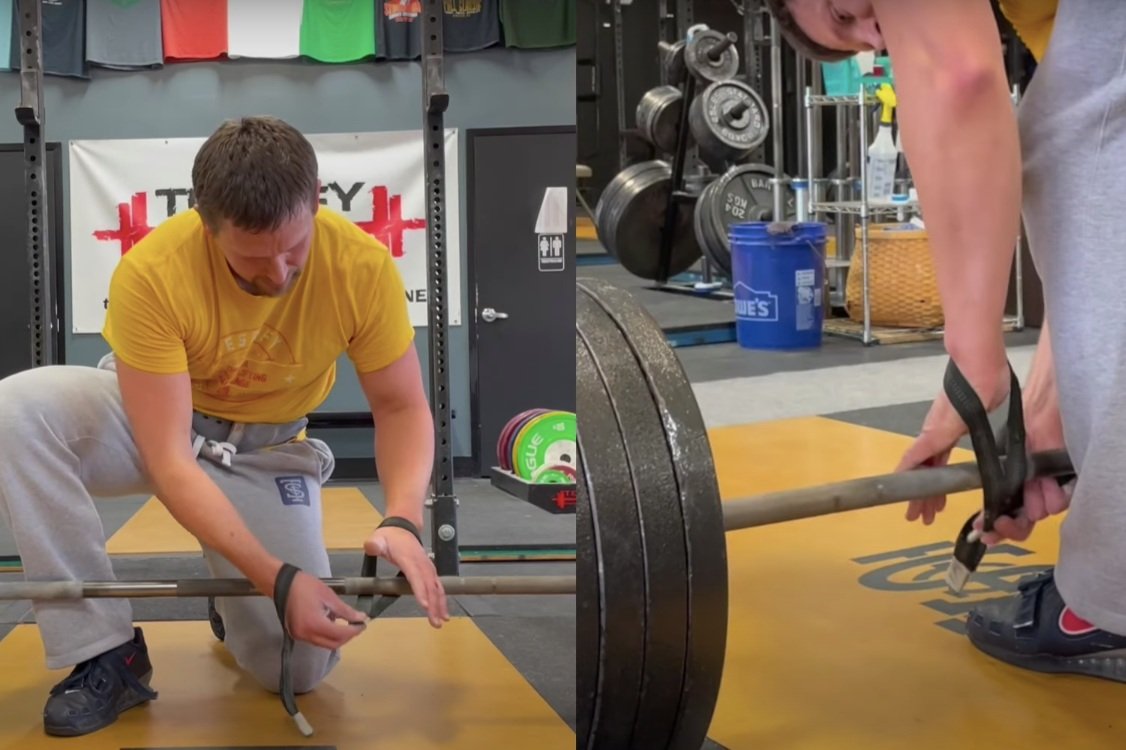
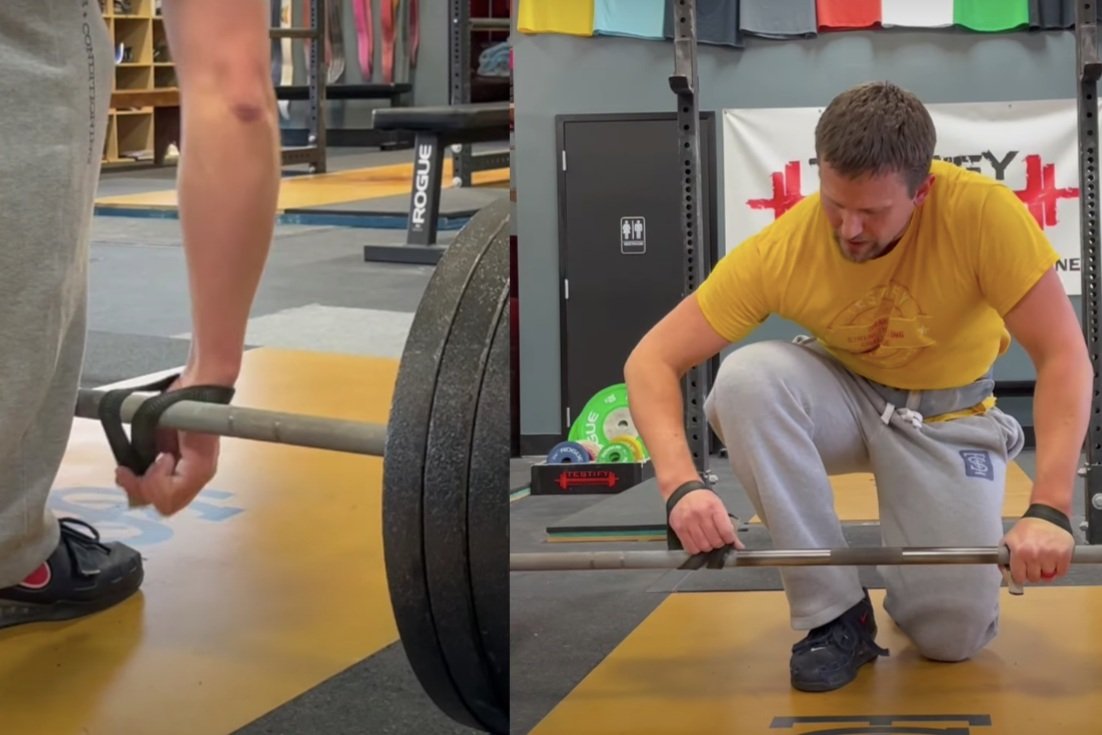
Place your left hand on the barbell - your hand goes over the bar, and the strap goes behind the bar.
Step 3
Use your right hand to help wrap the strap around the bar once, pinning it into place with your left thumb.
Step 4
Repeat steps 2 and 3 to get your right hand and its strap securely attached to the barbell, but note that the right hand will have to do this on its own as it doesn’t get any help from your left hand, which is already attached to the bar.
Step 5
When you tighten up the right strap (i.e., when you make it so that it’s wrapped snugly around the bar), you may find that you have to allow the left strap to loosen just a bit so that both straps have the same amount of “snugness” against the bar. Once that’s done, you can rotate both hands to tighten up both straps.
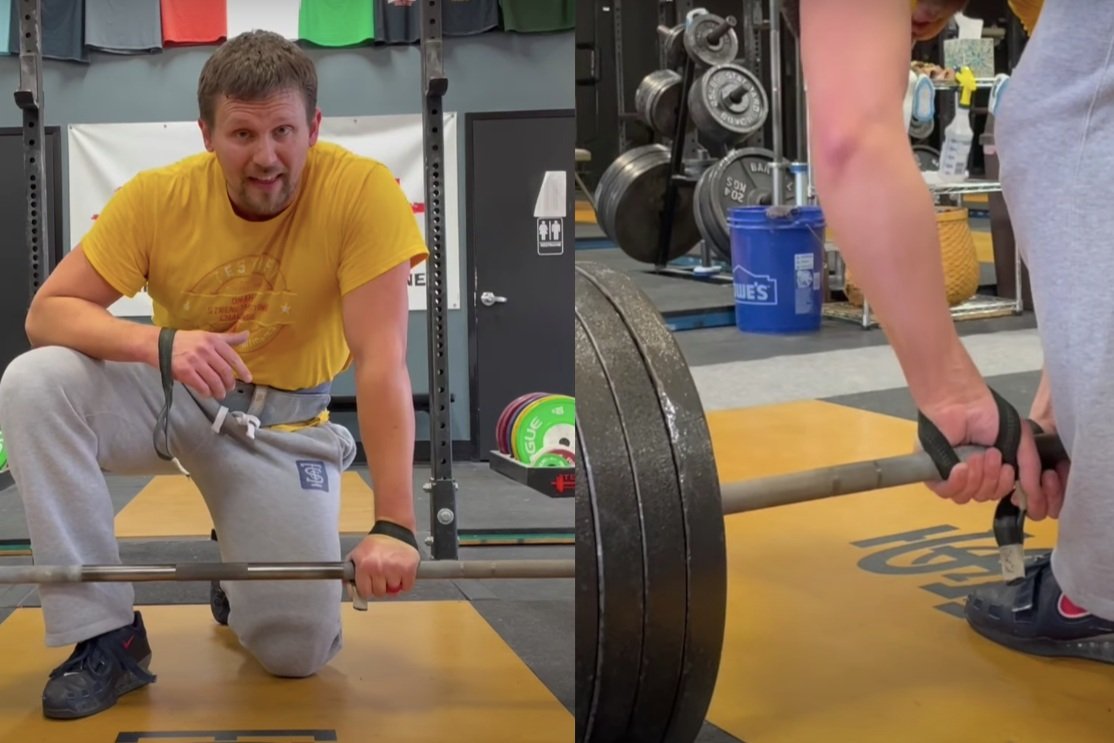
Step 6
Even though you’re using straps, be sure to still use chalk and grab the bar tightly. No hook grip is needed (don’t attempt a mixed grip either).
As always, we hope this helps you get stronger and live better.
(Some links may be affiliate links. As an Amazon Associate, Testify earns from qualifying purchases.)
If you found this helpful, you’ll love our weekly email. It’s got useful videos, articles, and training tips just like the one in this article. Sign up below, and of course, if you don’t love it, you can unsubscribe at any time.
At Testify, we offer small group training, private coaching (in-person or remotely via Zoom), online coaching, and form checks. Would you like to get quality coaching from a Starting Strength Coach?
Week 2022.09.19
/New on the Testify YouTube channel!
This Week’s Conditioning
Option 1
Sled
Outdoors:
10-20 x 25 yds EMOM at a weight of your choice
Every minute, push the sled 25 yards, i.e., if pushing the sled takes 20 seconds, then you have 40 seconds to rest. Perform 10-20 rounds.
Indoors:
10-20 x 100 ft EMOM at a weight of your choice
Every minute, push the sled 100 feet, i.e., if pushing the sled takes 20 seconds, then you have 40 seconds to rest. Perform 10-20 rounds.
Compare to 2022.07.18.
Option 2
Bike/row:
5 min on
4 min off
4 min on
3 min off
3 min on
2 min off
2 min on
1 min off
1 min on
Record distance for each interval and add for total distance.
Compare to 2022.06.27.
Option 3
5-10 rounds of:
30 sec ME tire flips
30 sec rest
Compare to 2022.05.30.
Option 4
For time:
500m row
5 x 80m sled push (200 ft if indoors)
500m row
Rest 1 minute after the first row and after each sled push.
Compare to 2022.05.30.