

If you’re only doing one set of something, the “1” for the number of sets is optional (remember multiplying by “1” in school?), so you can leave that part out if you like. In that case, it looks like this:

Week 2022.09.05
/Reminder: We are closed are Monday, 09/05/22, in observance of Labor Day.
New on the Testify YouTube channel!
This Week’s Conditioning
Option 1
Sled Pyramid – 4, 5, or 6 tiers
Go up and down a 4, 5, or 6 tier “sled pyramid” – rest as needed. The distance for each round is 80 m indoors (a down-back on the 40m course) or 200 ft outdoors (2 down-backs on the 50 ft course). Rest as needed.
For example, Bob does the following (4 tiers):
Round 1: Empty sled
Round 2: 25#
Round 3: 50#
Round 4: 75#
Round 5: 50#
Round 6: 25#
Round 7: Empty sled
Compare to 2022.07.04.
Option 2
Bike/Row for 9 rounds:
1 min on
1 min off
Record distance for each round.
Compare to 2022.06.13.
Option 3
1st: 5 x 50 ft seated sled pull. Add weight each round. Rest as needed.
2nd: 5 x 100 ft duck walk. Add weight each round. Rest as needed.
Compare to 2022.05.16.
Option 4
Outdoors
4 rounds:
50 yd farmer carry
80 m sled drag
Rest 2 min
Indoors
4 rounds:
100 ft farmer carry
100 ft sled drag
Rest 2 min
Compare to 2022.05.16.
The Pin Squat: What, How, and Why
/
In last Friday’s article, we covered the tempo squat. Today, let’s briefly discuss the pin squat.
What is a pin squat?
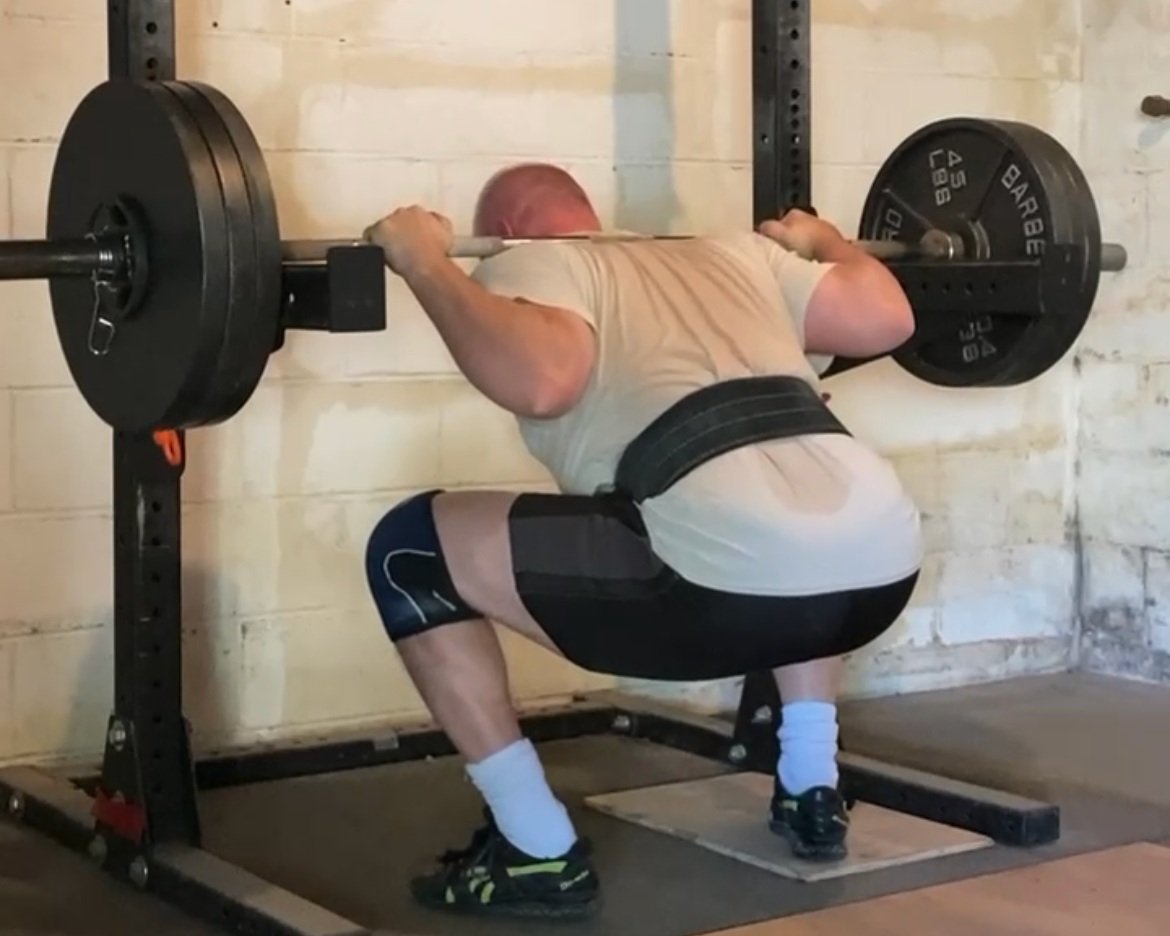
A pin squat is a squat wherein you descend, set the bar on the pins (AKA safeties, crash bars, or spotter arms) at the bottom of the squat, pause for a moment, and then squat the weight back up again.
How do you perform a pin squat?
You descend as you would in a normal squat - hips go back, knees go forward and out (staying in line with your toes), and your chest points down. The pins should be set so that - at the bottom of your squat (when the bar is on the pins) - your hip crease is just below the top of your patella.
In other words, the pins need to be set so that you can hit depth, and checking this on video is always a good idea if you’re coaching yourself.
Once both sides of the barbell are in contact with the pins, pause a legitimate one to two seconds (“one-thousand-one, one-thousand-two”), and stay tight during this pause. You should still be supporting most of the weight of the bar.
After the pause, drive the hips up out of the hole as you would in a normal squat and continue your ascent. Don’t be surprised at how slow the ascent is - pin squats are never fast.
Why might you do pin squats or where might you see them in your programming?
Let’s say your coach has programmed you within a Heavy-Light-Medium structure or something similar - in this case, you might see a pin squat show up as a medium day squat or even a light day squat (the loading and volume need to be carefully managed - especially if it’s a light day squat).
Due to the pause on the pins, the pin squat eliminates the stretch reflex out of the bottom, so it’s a disadvantaged squat, and thus you’ll need to use a lighter weight than with your regular squat, so it fits the bill for a medium or light squat.
However, as with last week’s tempo squat (click here for the article or check out the video earlier in this article), remember that “lighter” does not necessarily mean easy.
The pin squat - again like last week’s tempo squat - can also be useful for a number of other reasons - one of which is that it can help a lifter focus on a specific aspect of his technique.
For example, if Peter tends to squat with his knees too far forward and his back angle too vertical, a pin squat will encourage him to lean over more to get the bar down to the pins. On the other hand, if Mary struggles with hitting depth, a pin squat will force her to correct this - quite simply, if the bar doesn’t contact the pins, the rep doesn’t count (a box squat can be used for this as well). Finally, if Ben tends to relax and “get loose” as he descends, a pin squat will punish this type of behavior, and thus it will remind him to stay tight throughout the entire rep.
This wraps up our short discussion of the pin squat, and in an upcoming article, we’ll move on to the box squat.
As always, we hope this helps you get stronger and live better.
-Phil
PS: Whenever you want even more Testify in your life, here are some free resources:
Book a free intro and strategy session with us HERE.
Pick up a free copy of Testify’s Squat Guide: 12 Tips to Improve Your Squat Now HERE.
Get our free weekly email - containing useful videos, articles, and training tips - HERE.
Follow Testify on Instagram HERE.
Subscribe to Testify’s YouTube channel HERE.
(Some links may be affiliate links. As an Amazon Associate, Testify earns from qualifying purchases.)
At Testify, we offer small group training, private coaching (in-person or remotely via Zoom), online coaching, and form checks. Interested in getting stronger, looking better, and having more energy?
Week 2022.08.29
/Reminder: We will be closed on Monday, 09/05/22, in observance of Labor Day.
New on the Testify YouTube channel!
This Week’s Conditioning
Option 1
Sled
Outdoors:
10 rounds of:
Push sled 100 ft
Pull sled 100 ft (hand over hand)
Indoors:
20 rounds of:
Push sled 50 ft
Pull sled 50 ft (hand over hand)
Compare to 2022.06.27.
Option 2
Bike/row:
3 rounds of:
8 x 20 sec on/40 sec off
Rest 3 min between rounds
Score = lowest distance
Compare to 2022.06.06.
Option 3
1. Work up to a heavy single on the axle clean-and-press (i.e., ground to overhead).
2. 5 x 100 ft Zercher carry (50 ft down-back). Add weight each round. Rest as needed.
Compare to 2022.05.09.
Option 4
Outdoors:
5 rounds:
15 cal row
50 yd sled push, 100#/50#
Indoors:
5 rounds:
15 cal row
100 ft sled push, 250#/125#
Push sled slow for recovery. Score is slowest row.
Compare to 2022.05.09.
The Tempo Squat: What, How, and Why
/
What is a tempo squat?
A tempo squat is a squat wherein we assign a certain amount of time to each portion of the movement. Tempo squats are usually given with three numbers: the first represents the eccentric (or downward) phase of the lift, the second number represents the pause at the bottom (if any), and the third number represents the concentric (or upward) phase of the lift.
How do you perform a tempo squat?
We’ll use the example of the 3-0-3 tempo squat - also known as a Denver squat (since 303 is an area code for Denver). In a Denver squat, you spend three seconds going down, there is no pause at the bottom (since the middle number is zero), and then you spend three seconds going back up again.
Another example would be the 3-1-2 tempo squat - also known as a Chicago squat. In this case, you spend three seconds descending, you pause for one second at the bottom, and you then spend two seconds ascending again.
These are the most common tempos we use here at Testify, but of course, there are other options - literally an infinite number of options. With that being said, I’d advise you not to go off the deep end here, or your ego may be writing checks your body can’t cash.

Why might you do tempo squats or where might you see them in your programming?
Let’s say your coach has programmed you within a Heavy-Light-Medium structure or something similar - in this case, you might see tempo squats show up as a light or medium day squat. It’s not usually the first choice I’ll make for a light or medium day - I tend to keep it as simple as possible at first, and that means literally a lighter squat (usually in the 80-90% range), nothing fancier than that - but eventually, a lifter might see a tempo squat inserted there.
Why might we do that? A tempo squat - since it’s a slow, torturous event - will use a lighter weight than a normal squat, so it fits the bill for a light or medium squat (but note that light and medium do not mean easy).
The tempo squat can be also useful for a number of other reasons - one of which is that it can help a lifter focus on a specific aspect of his or her technique. If Bert tends to get forward at the bottom of his squat, a tempo squat allows him to think and focus very hard on maintaining his balance over the midfoot. If Ernie struggles to set his knees correctly on the descent, a tempo squat forces Ernie to take more time to do it correctly.

Tempo squats can also be used to help in cases of tendinopathy, and I have Will Morris to thank here for his recommendation of the 3-1-2 tempo squat (AKA Chicago squat). I will leave it to more educated professionals such as Will, John Petrizzo, Rori Alter, and Nick D’Agostino to give a detailed explanation of why this tends to work well - the people I just mentioned are all both physical therapists as well as Starting Strength Coaches and are excellent resources. From a purely physics perspective, I suspect that some of it has to do with the concept of impulse (i.e., change in momentum) and the inverse relationship between the force and time necessary to create a specific impulse. However, this is a topic for another day, so it suffices to say that tempo squats tend to be very useful in cases of tendinopathy.
This wraps up our discussion on tempo squats, and remember, if your coach programs them for you, there’s probably a good reason . . . or maybe your coach just likes to watch you suffer.
As always, we hope this helps you get stronger and live better.
(Some links may be affiliate links. As an Amazon Associate, Testify earns from qualifying purchases.)
If you found this helpful, you’ll love our weekly email. It’s got useful videos, articles, and training tips just like the one in this article. Sign up below, and of course, if you don’t love it, you can unsubscribe at any time.
At Testify, we offer small group training, private coaching (in-person or remotely via Zoom), online coaching, and form checks. Would you like to get quality coaching from a Starting Strength Coach?
Week 2022.08.22
/New on the Testify YouTube channel!
This Week’s Conditioning
Option 1
Sled
Outdoors:
10-20 x 25 yds EMOM at a weight of your choice
Every minute, push the sled 25 yards, i.e., if pushing the sled takes 20 seconds, then you have 40 seconds to rest. Perform 10-20 rounds.
Indoors:
10-20 x 100 ft EMOM at a weight of your choice
Every minute, push the sled 100 feet, i.e., if pushing the sled takes 20 seconds, then you have 40 seconds to rest. Perform 10-20 rounds.
Compare to 2022.06.20.
Option 2
Bike/row:
12 min TT
Score = distance
Compare to 2022.05.30.
Option 3
Outdoors:
8 rounds:
4 tire flips
50 yd sled push (25 yd down-back)
Rest 1 minute
Indoors:
8 rounds:
4 tire flips
100 ft sled push (50 ft down-back)
Rest 1 minute
Compare to 2022.05.02.
Option 4
5 rounds:
4 tire flips
8 sledgehammer strikes
6 pull-ups
10 push-ups
Pull-ups and push-ups can be modified – talk to the coaches for options.
Compare to 2022.05.02.