The Tempo Squat: What, How, and Why

What is a tempo squat?
A tempo squat is a squat wherein we assign a certain amount of time to each portion of the movement. Tempo squats are usually given with three numbers: the first represents the eccentric (or downward) phase of the lift, the second number represents the pause at the bottom (if any), and the third number represents the concentric (or upward) phase of the lift.

How do you perform a tempo squat?
We’ll use the example of the 3-0-3 tempo squat - also known as a Denver squat (since 303 is an area code for Denver). In a Denver squat, you spend three seconds going down, there is no pause at the bottom (since the middle number is zero), and then you spend three seconds going back up again.

Another example would be the 3-1-2 tempo squat - also known as a Chicago squat. In this case, you spend three seconds descending, you pause for one second at the bottom, and you then spend two seconds ascending again.

These are the most common tempos we use here at Testify, but of course, there are other options - literally an infinite number of options. With that being said, I’d advise you not to go off the deep end here, or your ego may be writing checks your body can’t cash.

Why might you do tempo squats or where might you see them in your programming? 
Let’s say your coach has programmed you within a Heavy-Light-Medium structure or something similar - in this case, you might see tempo squats show up as a light or medium day squat. It’s not usually the first choice I’ll make for a light or medium day - I tend to keep it as simple as possible at first, and that means literally a lighter squat (usually in the 80-90% range), nothing fancier than that - but eventually, a lifter might see a tempo squat inserted there.

Why might we do that? A tempo squat - since it’s a slow, torturous event - will use a lighter weight than a normal squat, so it fits the bill for a light or medium squat (but note that light and medium do not mean easy). 

The tempo squat can be also useful for a number of other reasons - one of which is that it can help a lifter focus on a specific aspect of his or her technique. If Bert tends to get forward at the bottom of his squat, a tempo squat allows him to think and focus very hard on maintaining his balance over the midfoot. If Ernie struggles to set his knees correctly on the descent, a tempo squat forces Ernie to take more time to do it correctly.

Tempo squats can also be used to help in cases of tendinopathy, and I have Will Morris to thank here for his recommendation of the 3-1-2 tempo squat (AKA Chicago squat). I will leave it to more educated professionals such as Will, John Petrizzo, Rori Alter, and Nick D’Agostino to give a detailed explanation of why this tends to work well - the people I just mentioned are all both physical therapists as well as Starting Strength Coaches and are excellent resources. From a purely physics perspective, I suspect that some of it has to do with the concept of impulse (i.e., change in momentum) and the inverse relationship between the force and time necessary to create a specific impulse. However, this is a topic for another day, so it suffices to say that tempo squats tend to be very useful in cases of tendinopathy.

This wraps up our discussion on tempo squats, and remember, if your coach programs them for you, there’s probably a good reason . . . or maybe your coach just likes to watch you suffer.

As always, we hope this helps you get stronger and live better.

(Some links may be affiliate links. As an Amazon Associate, Testify earns from qualifying purchases.)

If you found this helpful, you’ll love our weekly email. It’s got useful videos, articles, and training tips just like the one in this article. Sign up below, and of course, if you don’t love it, you can unsubscribe at any time.


At Testify, we offer small group training, private coaching (in-person or remotely via Zoom), online coaching, and form checks. Would you like to get quality coaching from a Starting Strength Coach?

Week 2022.08.22

This Week’s Conditioning

Option 1
Sled
Outdoors:
10-20 x 25 yds EMOM at a weight of your choice

Every minute, push the sled 25 yards, i.e., if pushing the sled takes 20 seconds, then you have 40 seconds to rest. Perform 10-20 rounds.

Indoors:
10-20 x 100 ft EMOM at a weight of your choice

Every minute, push the sled 100 feet, i.e., if pushing the sled takes 20 seconds, then you have 40 seconds to rest. Perform 10-20 rounds.

Compare to 2022.06.20.

Option 2
Bike/row:
12 min TT
Score = distance

Compare to 2022.05.30.

Option 3
Outdoors:
8 rounds:
4 tire flips
50 yd sled push (25 yd down-back)
Rest 1 minute

Indoors:
8 rounds:
4 tire flips
100 ft sled push (50 ft down-back)
Rest 1 minute

Compare to 2022.05.02.

Option 4
5 rounds:
4 tire flips
8 sledgehammer strikes
6 pull-ups
10 push-ups

Pull-ups and push-ups can be modified – talk to the coaches for options.

Compare to 2022.05.02.

Spotting the Squat: Don't Make These Mistakes!

Spotting the squat is important, but it’s often done terribly and awkwardly, so let’s briefly discuss how NOT to spot the squat.

Don’t Space Out.
This isn’t the time for selfies or catching up on your pleasure reading. You need to keep your hands off the barbell unless it moves in a direction other than upward, but you still need to be available and attentive throughout the entire set.

A missed rep can happen quickly, especially if it’s due to a loss of balance, so be ready.

figure 1: Don’t Do This. (note the crooked barbell)

Don’t Touch the Bar . . . When the Lifter is Walking It Back In.
At the end of a successful set, do not try to help the lifter get the bar back to the hooks (Figure 1). By touching the bar, you’ll simply cause the lifter to be uneven (because you and the other spotter will not provide equal amounts of assistance) and possibly miss one or both of the hooks.

At the end of a set, the lifter already squatted the weight on his own - he can certainly walk it back on his own. Spotters should simply be present as the bar contacts the uprights to make sure that the bar does not bounce back from the rack.

figure 2: Don’t be like these fools.

No 1-Person Spots
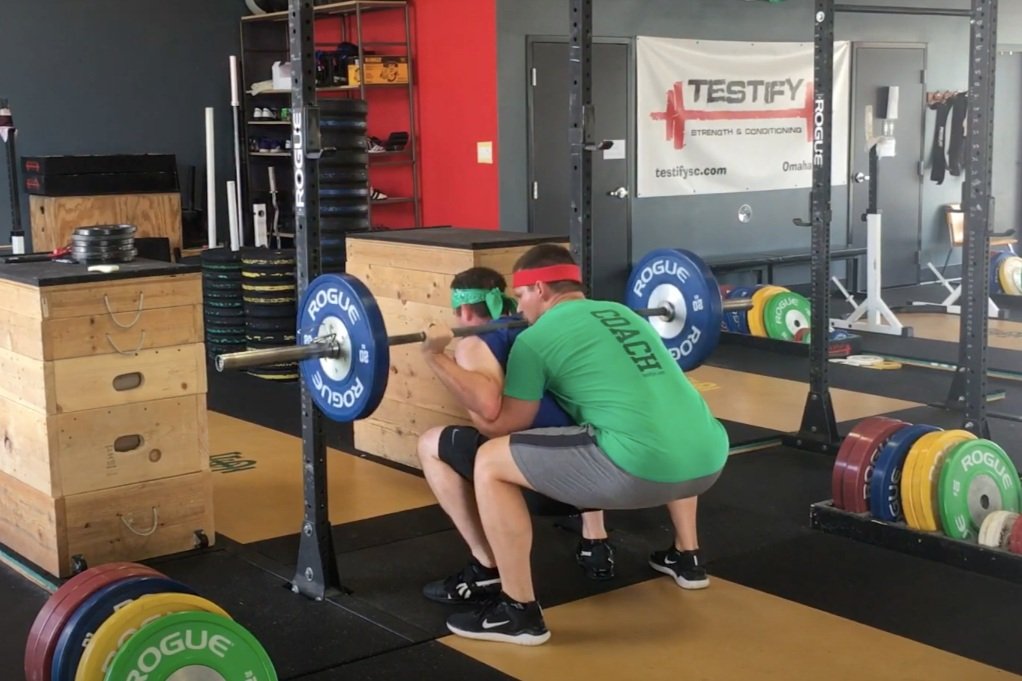
Spotting the squat is performed by two people - never one person. Spotting the squat from behind the lifter is awkward at best and dangerous at worst as the spotter is in a terrible position to handle a heavy load should the lifter fail (Figure 2).

When setting up to spot, the spotter on the lifter’s left should have his left foot forward, and the spotter on the lifter’s right should have his right foot forward - this way, you are both facing the lifter as well as each other.

Keep your hands off the bar unless the bar moves in a direction other than up - any rep touched by you cannot be counted by the lifter. However, if the lifter does need assistance, you need to provide it, and you do so by spotting the bar with the crook of your elbow, and both hands will help by grabbing the plate (Figure 3). At this point, the lifter and the spotters together will lift the bar and take it back to the hooks (the lifter should NEVER abandon the bar).

Figure 3: The correct way to spot a failed rep

As always, we hope this helps you get stronger and live better.

(Some links may be affiliate links. As an Amazon Associate, Testify earns from qualifying purchases.)
If you found this helpful, you’ll love our weekly email. It’s got useful videos, articles, and training tips just like the one in this article. Sign up below, and of course, if you don’t love it, you can unsubscribe at any time.


At Testify, we offer small group training, private coaching (in-person or remotely via Zoom), online coaching, and form checks. Would you like to get quality coaching from a Starting Strength Coach?

Week 2022.08.15

This Week’s Conditioning

Option 1
Sled
Outdoors:
10 rounds of:
Push sled 100 ft
Pull sled 100 ft (hand over hand)

Indoors:
20 rounds of:
Push sled 50 ft
Pull sled 50 ft (hand over hand)

Compare to 2022.06.13.

Option 2
Bike/row:
8 x 30 sec on/2:00 off

Score = least distance covered in any 30 second interval

Compare to 2022.05.23.

Option 3
5-10 rounds:
50 ft yoke carry
50 ft yoke push
100 ft sandbag carry and S.O.B. (sandbag-over-bar)

Perform 1 round every 2-3 minutes.

Compare to 2022.04.25.

Option 4
Row/Tire 10 min ladder:
2 cal row
2 tire flips
4 cal row
4 tire flips
6 cal row
6 tire flips

Climb the ladder as high as possible in 10 minutes.

Compare to 2022.04.25.

Spotting the Bench Press: Don't Make These Mistakes!

Spotting the bench press shouldn’t be complicated, but people mess it up frequently, so let’s briefly discuss how NOT to spot the bench press.

Don’t Yank Your Lifter Out of Position
Take an over-under grip on the barbell (i.e., one hand facing up and one hand facing down - also known as an alternating grip or mixed grip) and simply provide enough assistance to help guide the bar into place. Don’t pull your lifter out of position because you’re so eager to help.

Stay Out of Your Lifter’s Line of Sight
You should give your lifter an unobstructed line of sight to the ceiling; with this in mind, stay relatively close to the bench so you can provide assistance if necessary, but beyond that, stay out of the way. Don’t straddle the bench, don’t straddle your lifter (yes, I’ve seen this), and don’t even lean over your lifter.

Keep your hands, your face, and your body out of the way and out of your lifter’s line of sight - none of those things are in the way of your lifting buddy on his other lifts, and they shouldn’t be in the way on the bench press, either.

Don’t Space Out
Pay attention to your lifter. Get your hands out of your pockets, put down your coffee, and simply pay attention to your lifter so that - in the event that he needs assistance - you’re actually prepared to provide it.

Don’t Touch the Bar
This is the big one, folks - they’ve even got shirts about this one. Lifting is not a team sport. Benching is not a team sport. If you touch the bar, the rep doesn’t count, so stay out of the way. Don’t. Touch. The. Bar.

“I’m all pinkies, bro!” Don’t be like these fools.

Of course, you need to be able to provide assistance in the event that the barbell goes anywhere other than up, but beyond that, stay out of your lifter’s way. The spotter shouldn’t exist (figuratively speaking) unless the lifter needs help.

As always, we hope this helps you get stronger and live better.

(Some links may be affiliate links. As an Amazon Associate, Testify earns from qualifying purchases.)

If you found this helpful, you’ll love our weekly email. It’s got useful videos, articles, and training tips just like the one in this article. Sign up below, and of course, if you don’t love it, you can unsubscribe at any time.


At Testify, we offer small group training, private coaching (in-person or remotely via Zoom), online coaching, and form checks. Would you like to get quality coaching from a Starting Strength Coach?

Week 2022.08.08

This Week’s Conditioning

Option 1
Sled Pyramid – 4, 5, or 6 tiers
Go up and down a 4, 5, or 6 tier “sled pyramid” – rest as needed. The distance for each round is 80 m indoors (a down-back on the 40m course) or 200 ft outdoors (2 down-backs on the 50 ft course). Rest as needed.

For example, Bob does the following (4 tiers):
Round 1: Empty sled
Round 2: 25#
Round 3: 50#
Round 4: 75#
Round 5: 50#
Round 6: 25#
Round 7: Empty sled

Compare to 2022.06.06.

Option 2
Bike/row:
4 x 800m

Rest 3 minutes between each round. Score = slowest time.

Compare to 2022.05.16.

Option 3
Outdoors:
5-10 rounds:
10 sledgehammer strikes (5R, 5L)
50 yd farmer carry (25 yd down-back)
Rest 1 minute

Indoors:
5-10 rounds:
10 sledgehammer strikes (5R, 5L)
100 ft farmer carry (50 ft down-back)

Rest 1 minute

Compare to 2022.04.18.

Option 4
5-8 rounds:
50 ft sled push
50 ft sled pull (hand over hand)
Row 1 minute
Rest 1 minute

This can also be done in a group of three where the sledder determines how long the other two people row and rest.

Compare to 2022.04.18.


At Testify, we offer small group training, private coaching (in-person or remotely via Zoom), online coaching, and form checks. Would you like to get quality coaching from a Starting Strength Coach?