

Week 2022.08.01
/New on the Testify YouTube channel!
This Week’s Conditioning
Option 1
”Prowler Base+1”
1. Load up a manageable weight.
2. Sprint 40m at 85% intensity.
3. Rest 30 sec.
4. Repeat 5-15 times.
Courtesy of “Death by Prowler” (on Starting Strength).
Compare to 2022.05.30.
Option 2
Bike/row:
4 x 3 minutes
Rest 3 minutes between each round. Score = lowest distance.
Compare to 2022.05.09.
Option 3
5-10 rounds of:
30 sec ME tire flips
30 sec rest
Compare to 2022.04.11.
Option 4
1. 5 yoke carries @ 30 yd (15 yd downback) – work up to heaviest carry
2. 5 rounds of 5 reps on the axle “clean and press away” – work up to heavy set of 5
Compare to 2022.04.11.
The Deadlift: You're Doing This Wrong - Part 6
/
This is Part 6 in our series of articles on common deadlift errors and how to fix them. Today’s error is that of trying to jerk or yank the barbell off of the floor.

Jaden . . . is NOT doing this wrong. He’s about to pull very smoothly.
This is a common problem for new lifters, and indeed, you might even be able to get away with this error when the weight is light, but it will cause problems when the weight gets heavy (your back will flex or you’ll get pulled forward), and by then, you’ll have created a bad habit that’s harder to break.
This error is usually related to step 4 of the deadlift setup process. In step 4, the lifter squeezes the chest up to set the back in extension, and when you do this, be sure to start applying some tension to the bar; in other words, there needs to be some upward pull on the bar when you set your back. Below are a few cues that can help (and we covered some of these in a previous article as well):
“Bend the bar” or “Bend it before you break it”
When you squeeze your chest up to set your back, try to bend the bar upward in the middle. If the bar is heavy enough, it actually will bend, but try to bend it upward regardless of the weight on the bar. “Bend it before you break it” simply means that you try to bend the bar before you try to break it off the floor.
“Pull the slack out of the bar” or “Pull the click out of the bar”
Barbells and plates have some “slop” in them, and when you set your back hard and apply tension to the bar through your long, straight arms, you should be pulling upward enough that this slop disappears. If you do this correctly, you’ll hear a click from the bar and the plates.
“Heavy in the hands”
When you apply upward tension as you set your back, do so hard enough that the bar starts to feel heavy as you’re hanging onto it. This is because you are starting to support some of the weight as the floor starts to support less of the weight.
After using one of these cues to help you set your back with tension on the bar, simply remind yourself to break the bar smoothly off the ground (or “squeeze” the bar off the floor), and you’ll have created a smooth, strong deadlift.
As always, we hope this helps you get stronger and live better.
(Some links may be affiliate links. As an Amazon Associate, Testify earns from qualifying purchases.)
If you found this helpful, you’ll love our weekly email. It’s got useful videos, articles, and training tips just like the one in this article. Sign up below, and of course, if you don’t love it, you can unsubscribe at any time.
At Testify, we offer small group training, private coaching (in-person or remotely via Zoom), online coaching, and form checks. Would you like to get quality coaching from a Starting Strength Coach?
Week 2022.07.25
/New on the Testify YouTube channel!
This Week’s Conditioning
Option 1
“Prowler Base”
1. Load up a manageable weight.
2. Sprint 40m at 85% intensity.
3. Rest until breathing and heart rate slow down. (45 sec – 2 min)
4. Repeat 5-15 times.
Courtesy of “Death by Prowler” (on Starting Strength).
Compare to 2022.05.23.
Option 2
Bike/row:
5 min on
4 min off
4 min on
3 min off
3 min on
2 min off
2 min on
1 min off
1 min on
Record distance for each interval and add for total distance.
Compare to 2022.05.02.
Option 3
Outdoors:
5-10 rounds:
50 yd sled push (25 yd down-back)
50 yd farmer carry (25 yd down-back)
Rest 1 min
Indoors:
5-10 rounds:
100 ft sled push (50 ft down-back)
100 ft farmer carry (50 ft down-back)
Rest 1 min
Compare to 2022.04.04.
Option 4
10 x 50 ft farmer carry
Each carry is 25 ft down and 25 ft back and is for time. Rest 1 minute between carries.
Women: 97# per handle (80# of plates)
Men: 137# per handle (120# of plates)
(Note: Each handle weighs 17#.)
Compare to 2022.04.04.
The Deadlift: You're Doing This Wrong - Part 5
/
This is Part 5 in our series of articles on common deadlift errors and how to fix them. Today’s error is that of having a compromised grip.
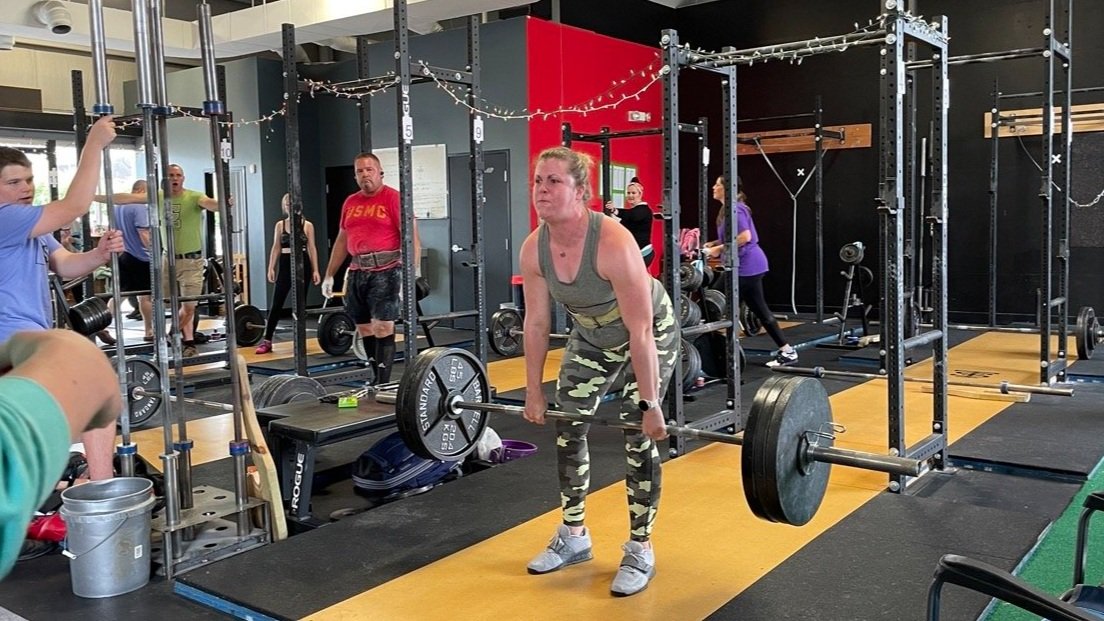
Don’t worry - Brianne is NOT doing this part wrong.
Grip should never be the limiting factor when deadlifting. After all, the deadlift is a tremendous developer of leg, hip, and back strength, so it seems rather silly and shortsighted to blunt the training effect of the deadlift simply because we’re doing stupid things with our grip. Of course, YOU’RE not being stupid with your grip, but some people are.
Two points here:
1. Your double overhand grip won’t cut it anymore.
When the weight gets heavy enough, a double overhand grip will no longer do the job (a double overhand grip is one wherein both hands are pronated, i.e., hands in front of the barbell with palms facing backward).
This isn’t a strength issue - the double overhand grip is simply not a terribly strong position for the hands to begin with, so don’t stress out about it. Instead, simply start using either a hook grip or a mixed grip (AKA “alternating grip” or “switch grip”).
There are no bonus points for taking your double-overhand-grip-deadlift as heavy as possible. We care about heavy deadlifts . . . nobody cares about not-so-heavy-and-artifically-limited-double-overhand-grip-deadlifts.
2. Chalk is mandatory. Tell your lifting buddy to stop being a fool about this.
Friction is important for grip, and everyone’s hands have a certain amount of natural moisture - oil, sweat, etc. - that inhibits friction. The absorption of this moisture - and the corresponding increase in grip strength that accompanies this absorption - is why rock climbers and gymnasts use chalk, and it’s why we use chalk when lifting.
Chalk is useful in all lifts (yes, even squatting, benching, and pressing), but it is absolutely critical in pulling movements such as the snatch, clean, and the deadlift. Use chalk. Put some on your hands when you start your lifting, reapply when you start warming up your deadlift, and certainly reapply when you get to your deadlift workset(s).
All my thoughts on people who don’t use chalk (or enough chalk) start to get rather grumpy past this point, so I’ll stop here.
In summary, use the appropriate grip and use chalk - these two points will help you develop a stronger deadlift and therefore a stronger you.
As always, we hope this helps you get stronger and live better.
(Some links may be affiliate links. As an Amazon Associate, Testify earns from qualifying purchases.)
If you found this helpful, you’ll love our weekly email. It’s got useful videos, articles, and training tips just like the one in this article. Sign up below, and of course, if you don’t love it, you can unsubscribe at any time.
At Testify, we offer small group training, private coaching (in-person or remotely via Zoom), online coaching, and form checks. Would you like to get quality coaching from a Starting Strength Coach?
Week 2022.07.18
/New on the Testify YouTube channel!
This Week’s Conditioning
Option 1
Sled
Outdoors:
10-20 x 25 yds EMOM at a weight of your choice
Every minute, push the sled 25 yards, i.e., if pushing the sled takes 20 seconds, then you have 40 seconds to rest. Perform 10-20 rounds.
Indoors:
10-20 x 100 ft EMOM at a weight of your choice
Every minute, push the sled 100 feet, i.e., if pushing the sled takes 20 seconds, then you have 40 seconds to rest. Perform 10-20 rounds.
Compare to 2022.05.16.
Option 2
Bike/row:
4 x 3 minutes
Rest 3 minutes between each round. Score = lowest distance.
Compare to 2022.04.25.
Option 3
8 rounds:
Outdoors:
4 tire flips
50 yd sled push (25 yd down-back)
Rest 1 minute
Indoors:
4 tire flips
100 ft sled push (50 ft down-back)
Rest 1 minute
Compare to 2022.03.28.
Option 4
Sandbag-over-bars
Set yoke at #33 for women or #35 for men.
1. 1 minute AMRAP
2. 5 rounds of 2 reps every 2 minutes (speed!)
3. 1 minute AMRAP
Weights
Female under 40 years
140 lbs and under: 75 lbs
140.1 lbs – 185 lbs: 100 lbs
185.1 lbs and over: 150 lbs
Female 40 years and over
140 lbs and under: 50 lbs
185 lbs and under: 75 lbs
185.1 lbs and over: 100 lbs
Male under 40 years
185 lbs and under: 150 lbs
185.1 lbs – 235 lbs: 200 lbs
235.1 lbs and over: 250 lbs
Male 40 years and over
185 lbs and under: 100 lbs
185.1 lbs – 235 lbs: 150 lbs
235.1 lbs and over: 200 lbs
Compare to 2022.03.28.