Week 2020.09.21

This Week’s Conditioning

Option 1
“Prowler Base”
1. Load up a manageable weight.
2. Sprint 40m at 85% intensity.
3. Rest until breathing and heart rate slow down. (45 sec – 2 min)
4. Repeat 5-15 times.

Courtesy of “Death by Prowler” (on Starting Strength).

Compare to 2020.08.10.

Option 2
Bike/row:
5 min on
4 min off
4 min on
3 min off
3 min on
2 min off
2 min on
1 min off
1 min on

Record distance for each interval and add for total distance.

Compare to 2020.07.27.

Option 3
Outdoors:
5-10 rounds:
50 yd sled push (25 yd down-back)
50 yd farmer carry (25 yd down-back)
Rest 1 min

Indoors:
5-10 rounds:
100 ft sled push (50 ft down-back)
100 ft farmer carry (50 ft down-back)
Rest 1 min

Compare to 2020.06.29.

Option 4
5-8 rounds:
50 ft sled push
50 ft sled pull (hand over hand)
Row 1 minute
Rest 1 minute

This can also be done in a group of three where the sledder determines how long the other two people row and rest.

Compare to 2020.06.22.

Stop Winding Up the Press

IMG_1980.jpg

When we move the hips forward at the start of the press, we do so for a couple of reasons. First, it gets the head out of the way to clear a path for the bar to travel vertically, and second, it initiates a stretch reflex out of the bottom of the press to help propel the bar upward.

A common problem, however, with this “reach-and-bounce” or “reach-and-press” movement at the start of the press is that of winding up the press. When you use the hips at the start of the press, the hips should begin by moving forward and then back to their starting position. You absolutely should NOT initiate the press by moving the hips backward first, then forward - this is winding up the press. It creates unnecessary horizontal movement of the bar - a forward-and-backward motion of the bar that is a waste of time and energy, and what is more, this horizontal movement has to be managed, which becomes very difficult indeed at heavy weights. We are trying to move the bar vertically upward, so any unnecessary horizontal motion makes our job that much harder.

To fix this problem, let’s first focus on the start position. Simply put, you stand as tall as possible before initiating the movement. You may find that you tend to lower the previous, finished rep to a position wherein your hips are already reaching forward of neutral; in other words, you look like you’re about to perform the limbo at a birthday party (but with straight knees, which is a terrible way to perform the limbo anyway) instead of returning to a normal, upright, standing position. This will either reduce the effectiveness of a correct hips movement as your hips are already in a “pre-reached” position, or you will start the next rep by yanking your hips backward first - the winding up motion that we are trying so diligently to avoid. If you find that you tend to start your press in this pre-reached position, then at the completion of each rep, after lowering the bar, simply cue yourself to “stand up” or even “stand up tall.” 

IMG_1981.jpg

Some lifters start the press in the correct position but still move the hips backward first. This is sometimes due to a subconscious effort to get a bigger bounce out of the hips. As this bigger bounce doesn’t actually occur, and since that hateful horizontal movement of the bar does occur, we’re going to stop doing this. To do so, try this: as you’re getting set to press, take a breath, get tight (performing your usual Valsalva maneuver), and then cue yourself, “Forward. Only forward.” In other words, you are commanding your hips to move in the forward direction only. Backward movement is never considered.

If you wind up your press, give one of these cues a try. Use the cue on every single warm-up rep - making a change when the weight is already heavy is very difficult to do, and focusing on the cue during your warm-ups allows you to think about and execute the cue at a weight at which you actually can spare some mental bandwidth. Give it a shot.

Week 2020.09.14

This Week’s Conditioning

Option 1
“Prowler Sprint Test”
1. Load up a heavier weight.
2. Time a 15 yards sprint at 100% intensity.
3. Rest 30 seconds.
4. Repeat sprint until times slows down 10%.
5. Goal is to increase # of sprints under the time standard.

Courtesy of “Prowler Sprint Test” (on JTS) as well as “Death by Prowler” (on Starting Strength).

Compare to 2020.08.03.

Option 2
5 rounds:
10 cal bike
1 min rest
4 sandbag-over-bars
1 min rest

Set the yoke crossmember at 35/33, and the weight is 150#/75#.

Compare to 2020.07.20.

Option 3
8 rounds:
Outdoors:
4 tire flips
50 yd sled push (25 yd down-back)
Rest 1 minute

Indoors:
4 tire flips
100 ft sled push (50 ft down-back)
Rest 1 minute

Compare to 2020.06.22.

Option 4
1. 5 yoke carries @ 30 yd (15 yd downback) – work up to heaviest carry
2. 5 rounds of 5 reps on the axle “clean and press away” – work up to heavy set of 5

Compare to 2020.06.15.

The Stretch Reflex and Thinking "Up" in the Squat

IMG_4390.jpg

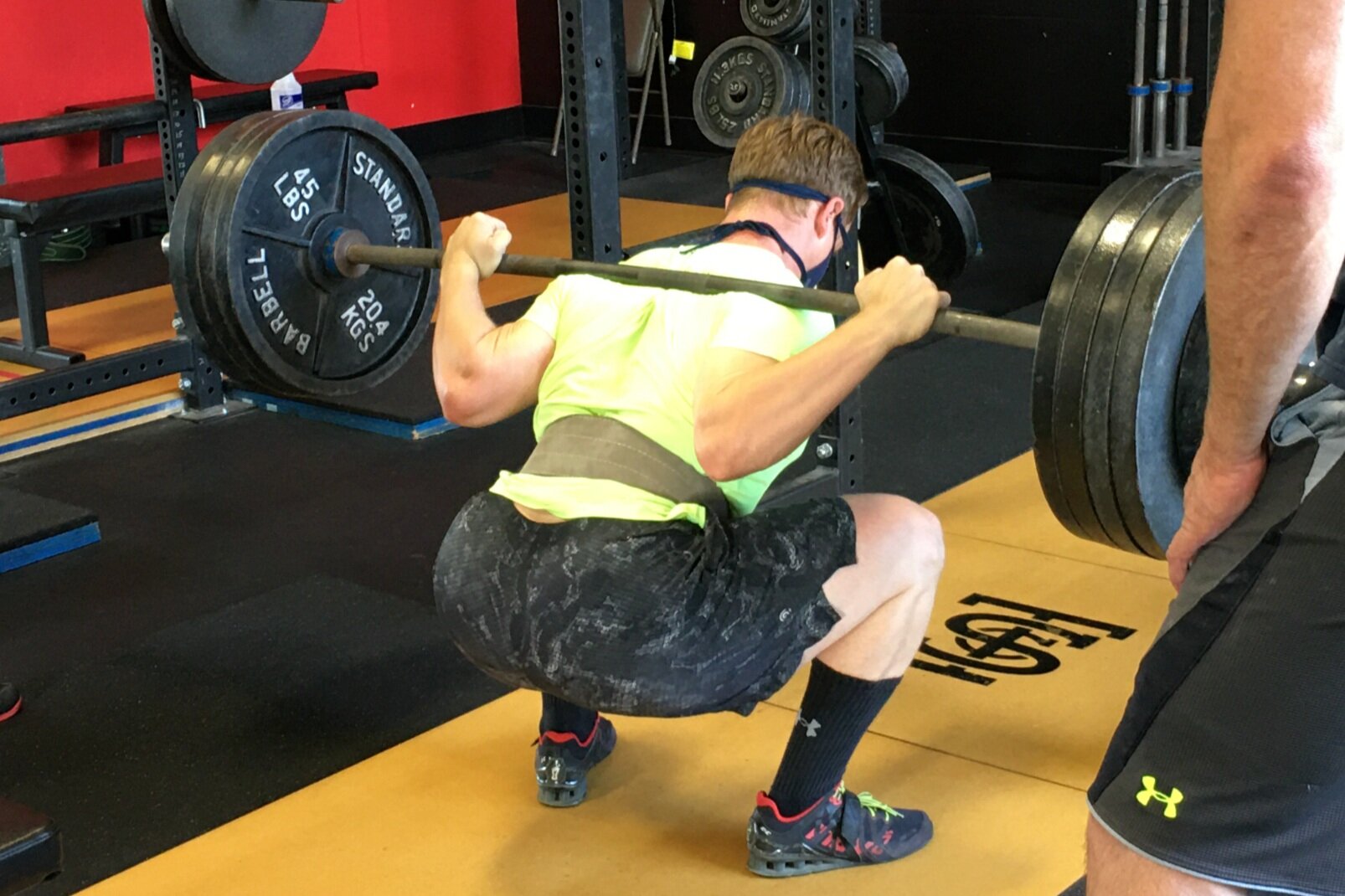
When we squat, we like to do so as effectively and efficiently as possible, and to do that, we utilize something called the stretch reflex, or the bounce, to come up out of the bottom of the hole. A stretch reflex is your body’s response to the stretching (i.e., lengthening) of your muscles - in this case, during the descent of the squat - and if you take advantage of it, it makes for a stronger squat. 

For a new lifter, two common problems with the stretch reflex are that the lifter will either pause at the bottom of the squat or the lifter will descend too quickly. Pausing mutes the effect of the stretch reflex and makes the squat harder than it should be. On the other hand, descending too quickly means the lifter is going to have to deal with a lot of unnecessary downward momentum to turn the squat around, and this results in a loose, sloppy, and quite difficult turnaround at the bottom of the movement, and once again, the benefit of the stretch reflex is lost.

If you find yourself either pausing at the bottom of your squat or descending too quickly, try this - think “UP” all the way down. As soon as you start your descent, you think “up,” and you keep thinking “up” until you reach the bottom of the squat, at which point you immediately execute this “up” motion that you’ve been thinking about and preparing for throughout the entire descent.

It’s a simple cue, and it tends to correct both the “pausers” as well as the “dive-bombers.” If you fit either label, give it a try.

Week 2020.09.07

Reminder: The gym will be closed on Monday, 09/07/20, in observance of Labor Day.

This Week’s Conditioning

Option 1
Sled
Outdoors:
10-20 x 25 yds EMOM at a weight of your choice

Every minute, push the sled 25 yards, i.e., if pushing the sled takes 20 seconds, then you have 40 seconds to rest. Perform 10-20 rounds.

Indoors:
10-20 x 100 ft EMOM at a weight of your choice

Every minute, push the sled 100 feet, i.e., if pushing the sled takes 20 seconds, then you have 40 seconds to rest. Perform 10-20 rounds.

Compare to 2020.07.27.

Option 2
Bike/Row for 9 rounds:
1 min on
1 min off

Record distance for each round.

Compare to 2020.07.13.

Option 3
Outdoors:
10 rounds:
25 yd yoke carry
Rest 1 minute

Indoors:
10 rounds:
30 yd yoke carry (15 yd down-back)
Rest 1 minute

Compare to 2020.06.15.

Option 4
10 x 50 ft farmer carry
Each carry is 25 ft down and 25 ft back and is for time. Rest 1 minute between carries.

Women: 97# per handle (80# of plates)
Men: 137# per handle (120# of plates)
(Note: Each handle weighs 17#.)

Compare to 2020.06.08.

Your Training Log - Part 2: How to Keep One

IMG_4308.JPG

In last week’s article, Your Training Log - Part 1: Just Do It, we covered the importance of keeping a training log. Now that you’re utterly and forever convinced of the wisdom of keeping a training log, let’s discuss how to keep one. Your log needs to contain several basic elements organized in a readable fashion, but it’s not a complicated process. Grab a plain old composition notebook, and let’s get started.

First, give each week its own page. We tend to think and plan in these chunks called weeks anyway, so it makes sense to organize our training log this way as well. If you complete all your training for a given week and you have extra space at the bottom of the page, don’t be tempted to start another week on the same page. Again, each week gets its own page - no matter what - so start a new page every time you start a new week. The blank space on the preceding page will remind you that you didn’t do your job last week, and hopefully, this will compel you to do better this week.

IMG_4237.JPG

At the beginning of the week, divide your new page according to the number of days you train per week. For example, if you train three days per week, you’ll divide the page into three sections (horizontally or vertically - either will work). You can and will fit three or four days of training (even five!) onto one page, and allocating a specific amount of space to each day at the beginning of the week will ensure that you color inside the lines.

When training, label each lift, e.g., squat, press, deadlift, snatch, etc. Abbreviations are fine, but you need to be able to go back and understand what you’re written, so don’t get too clever there, Copernicus.

Next, write the goal - the prescription - for the lift you’re about to perform. If you’re planning to squat three sets of five reps for your work sets today, then simply write “3 x 5.” After that, write out your warm-ups and your work sets (remember, reps are always written second), and finally, write out what you’re going to lift next time. Here’s an example:

Squat
3 x 5 Today’s goal
----------
45 x 5 x 2
95 x 5 x 1
135 x 3 x 1 Warm-up sets
185 x 2 x 1
215 x 1 x 1
----------
240 x 5 x 3 Work sets
Next: 245

If you’re only doing one set of something, the “1” for the number of sets is optional (remember multiplying by “1” in school?), so you can leave that part out if you like. In that case, it looks like this:

Squat
3 x 5 Today’s goal
----------
45 x 5 x 2
95 x 5
135 x 3 Warm-up sets
185 x 2
215 x 1
----------
240 x 5 x 3 Work sets
Next: 245

IMG_4310.jpg

Beyond this, you’ll also want to write down cues that you’re using or will use next time (“Midfoot!”), reminders (“Next time, put belt on for last warm-up and all work sets”), and even how the training session went (“Smoked it today!”). Keeping a PR sheet somewhere in your training log is also a great idea, and perhaps we’ll cover that in a future article.

Of course, you can keep a training log anyway you want to, but this is my article, so you’re getting my recommendations. If you’d like to do it differently, that’s fine . . . just don’t tell me.