
Week 2020.12.21
/Reminder: Below are the hours for Christmas week (i.e., this week) and New Year’s week. You can also find these on our Location & Hours page and on the whiteboard at the gym. Any days not listed retain their normal hours.
Christmas week
Thursday, 12/24/20: Regular morning hours; closed in the afternoon/evening
Friday, 12/25/20: Closed
Saturday, 12/26/20: Regular hours
New Year’s week
Thursday, 12/31/20: Regular morning hours; closed in the afternoon/evening
Friday, 01/01/21: Closed
Saturday, 01/02/21: Regular hours
New on the Testify YouTube channel!
This Week’s Conditioning
Option 1
Sled
Outdoors:
10 rounds of:
Push sled 100 ft
Pull sled 100 ft (hand over hand)
Indoors:
20 rounds of:
Push sled 50 ft
Pull sled 50 ft (hand over hand)
Compare to 2020.10.12.
Option 2
Bike/row:
4 x 3 minutes
Rest 3 minutes between each round. Score = lowest distance.
Compare to 2020.09.28.
Option 3
Outdoors:
5-10 rounds:
10 sledgehammer strikes (5R, 5L)
50 yd farmer carry (25 yd down-back)
Rest 1 minute
Indoors:
5-10 rounds:
10 sledgehammer strikes (5R, 5L)
100 ft farmer carry (50 ft down-back)
Rest 1 minute
Compare to 2020.08.31.
Option 4
1. 5 yoke carries @ 30 yd (15 yd downback) – work up to heaviest carry
2. 5 rounds of 5 reps on the axle “clean and press away” – work up to heavy set of 5
Compare to 2020.08.24.
Lifting Clothes: The Good, the Bad, and the Bloody
/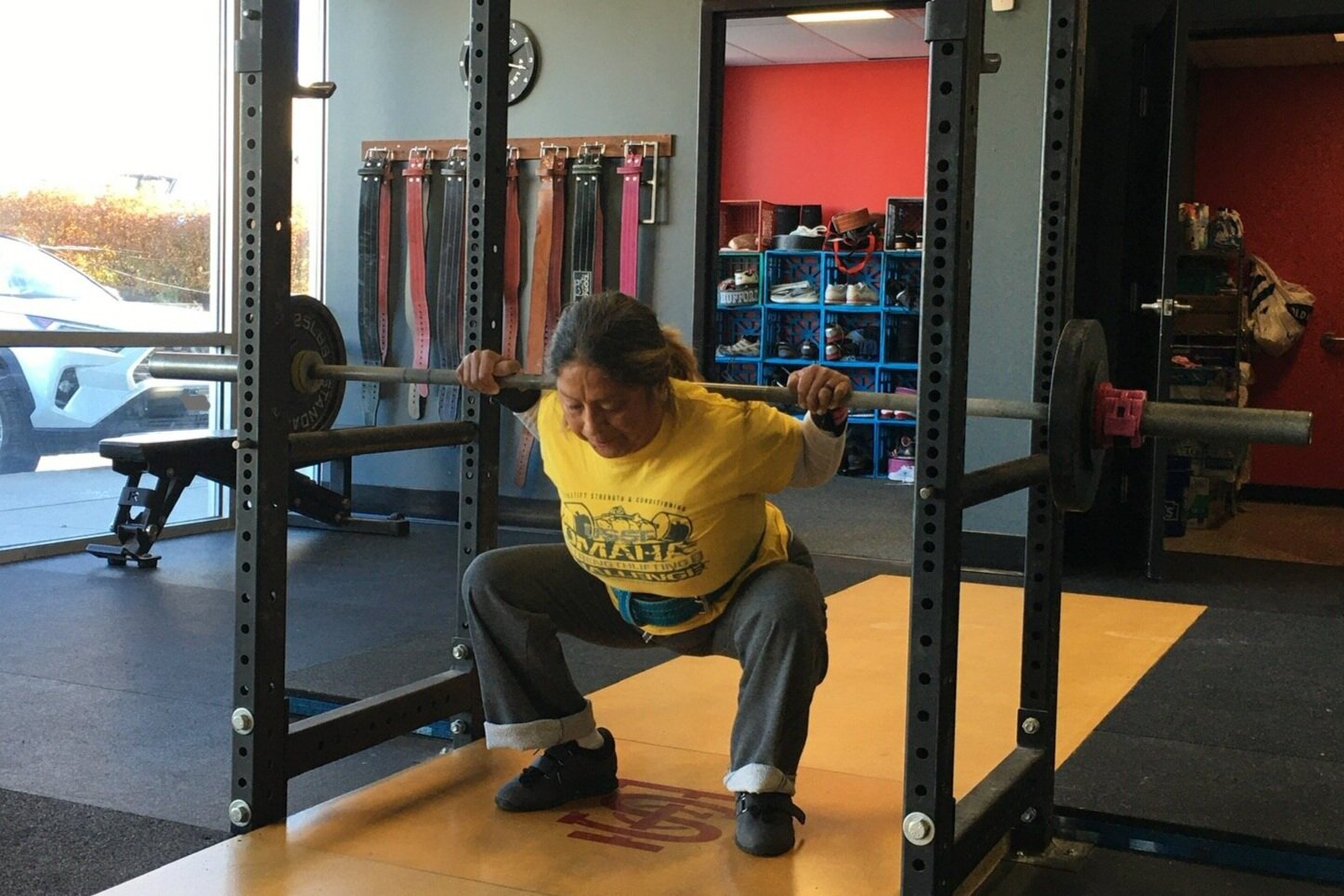
If you’re new to training, the topic of what to wear when lifting seems rather straightforward. Put on a shirt, put on some shorts, and you’re good to go, right? Not so fast. Let’s briefly (no pun intended) cover a few important considerations.
Shirt
Cotton is your best friend when it comes to your lifting shirts. T-shirts, long-sleeve shirts, and sweatshirts are all good options, but make sure they are made from plain, old cotton. Specifically, you don’t want to wear a “tech” shirt when lifting - these shirts are usually made of synthetic materials (such as polyester), and while they are great at wicking sweat away from your body and keeping you cool, they are slippery, and as a result, they are a terrible option when you have a barbell on your back, when you’re trying to stay put on a bench, or when you’re racking a clean on your shoulders.
Speaking of slick surfaces, stay away from tank tops as well. Tank tops put your sweaty, oily skin in contact with the bar (or bench), and a nice, cotton t-shirt provides significantly more friction - and therefore security - than does your skin.
Shorts or Pants
Choices abound here, and there are only a few considerations with which you need to be concerned. Sweatpants, leggings, and shorts are all on the table, but if you are wearing shorts, make sure they stop above the knee so they don’t create a binding effect at the knee when squatting. If they are too long, it’s not the end of the world - simply roll them up a time or two at the waistband to solve this problem (or stop clothing yourself like a 14-year-old basketball player). Sweatpants are fine, but if you tend to run hot, you might want to wear a pair of shorts underneath so you can ditch the sweatpants once you get warmed up.
Socks
Most any pair of athletic socks will do, but when it comes to deadlifting, snatching, and cleaning, keep your shins covered. By that, I mean keep all of your shins covered - up to just below the knee - so if you’re wearing shorts, put on some long socks (we’re talking “over-the-calf” long). It’s very easy to accidentally scrape your shin when pulling from the floor, and shins bleed easily, so once you’ve nicked your shin with the bar, it’s very easy to break that scab open again over the next several workouts. If you don’t own the barbell, keep your DNA off of it. If you do own the barbell, I suppose you can do what you like, but I’d rather keep my DNA internal anyway. Not only that, but you will do a better job of keeping the bar close to your shins when there is a layer of fabric between your skin and the bar.
Shoes
Wear lifting shoes. Don’t wear shoes that someone told you are good for lifting. Wear actual lifting shoes. For a more in-depth treatment of this, click here to watch our video. Do not wear Chucks. Chucks are the shoe for someone who started to think about lifting shoes but never completed the thought. Don’t do it.
Hopefully, this short guide helps you when laying out your clothes for your 5 a.m. lifting session tomorrow. Happy training.
Week 2020.12.14
/Reminder: Below are the hours for Christmas week (you can also find these on our Location & Hours page and on the whiteboard at the gym). Any days not listed retain their normal hours.
Thursday, 12/24/20: Regular morning hours; closed in the afternoon/evening
Friday, 12/25/20: Closed
Saturday, 12/26/20: Regular hours
New on the Testify YouTube channel!
This Week’s Conditioning
Option 1
Sled Pyramid – 4, 5, or 6 tiers
Go up and down a 4, 5, or 6 tier “sled pyramid” – rest as needed. The distance for each round is 80 m indoors (a down-back on the 40m course) or 200 ft outdoors (2 down-backs on the 50 ft course). Rest as needed.
For example, Bob does the following (4 tiers):
Round 1: Empty sled
Round 2: 25#
Round 3: 50#
Round 4: 75#
Round 5: 50#
Round 6: 25#
Round 7: Empty sled
Compare to 2020.10.05.
Option 2
Bike/row:
5 min on
4 min off
4 min on
3 min off
3 min on
2 min off
2 min on
1 min off
1 min on
Record distance for each interval and add for total distance.
Compare to 2020.09.21.
Option 3
5-10 rounds of:
30 sec ME tire flips
30 sec rest
Compare to 2020.08.24.
Option 4
10 x 50 ft farmer carry
Each carry is 25 ft down and 25 ft back and is for time. Rest 1 minute between carries.
Women: 97# per handle (80# of plates)
Men: 137# per handle (120# of plates)
(Note: Each handle weighs 17#.)
Compare to 2020.08.17.
Shin Angle and Your Deadlift
/
This deadlifter has a problem. Can you figure out what it is?
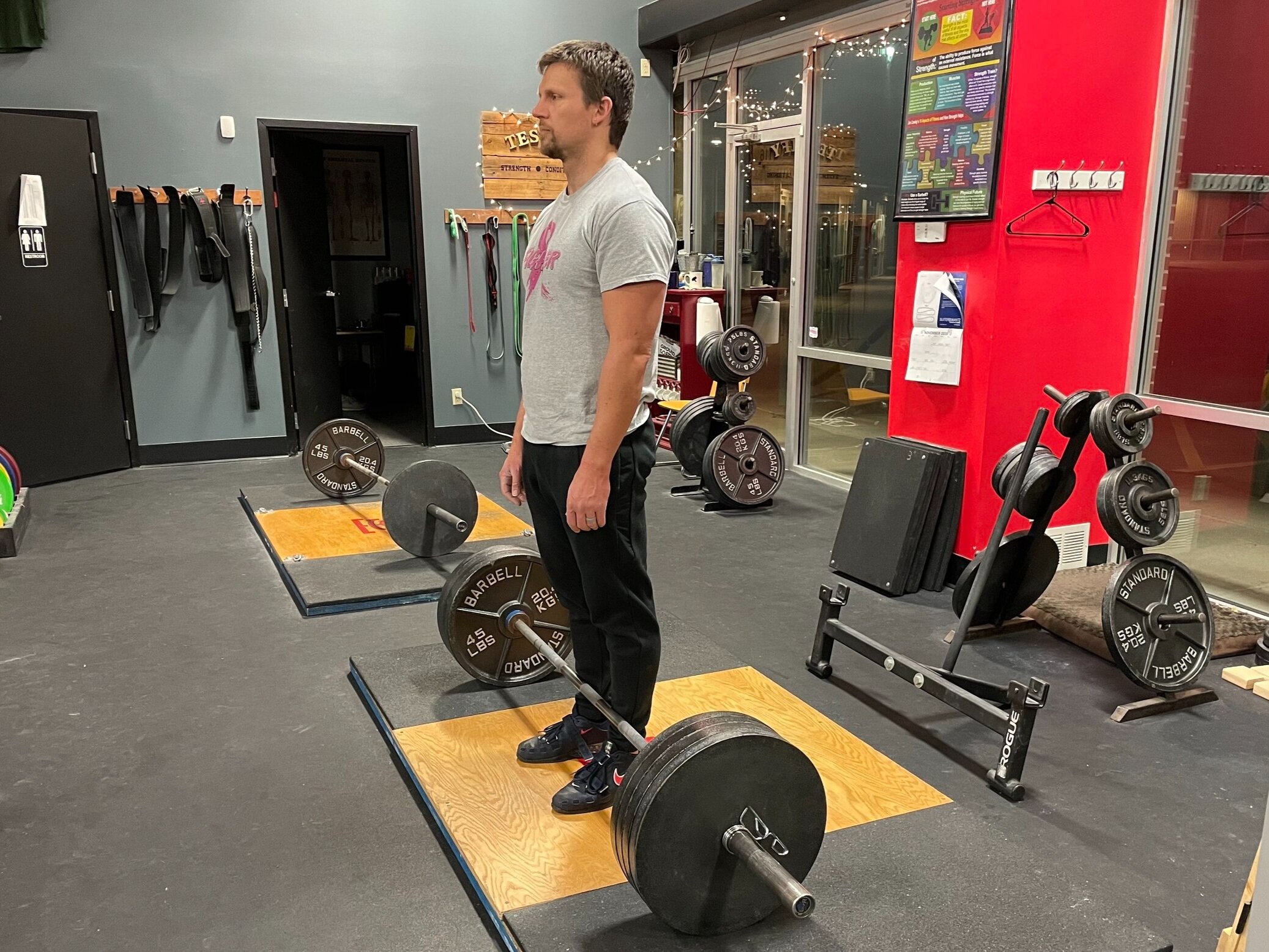
Incorrect stance - too close to the bar (shins actually touching the bar in this case)
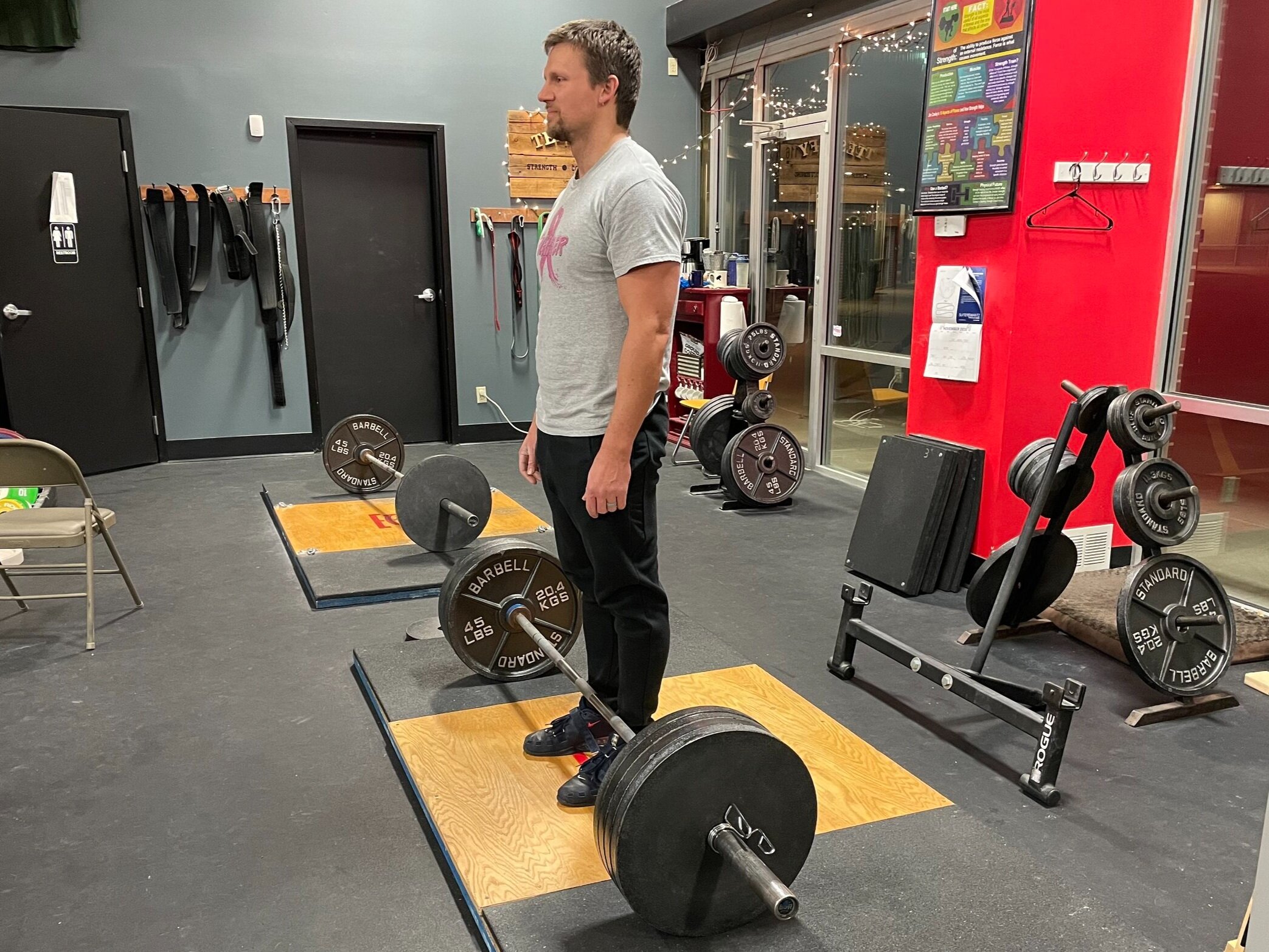
Correct stance with shins 1 inch from the bar.
In the setup for the deadlift, we sometimes see the problem of people setting up too close to the bar, and taking a look at your shin angle can help identify this problem. This problem is usually born of good intentions and is similar to the “shoving the knees too far out in the squat” problem (yes, that actually does happen with some people). We know we’re supposed to shove our knees out, and then we accidentally - and almost always unknowingly - overdo it. Likewise, in the deadlift, you know you’re supposed to set up close to the bar, and then you accidentally overdo it by setting up too close.
Remember, step #1 of the deadlift setup is “Set up with the bar over your midfoot - with your shins one inch from the bar.” It is NOT simply “Set up close to the bar.”
This is where looking at your shin angle can help. In the deadlift setup, at the start of the pull, everyone will have a small shin angle (measured from vertical) if the bar is over midfoot, i.e., the shin will be angled slightly forward, but the actual amount will vary slightly with anthropometry. With this variance in mind, there is no single shin angle that will be correct for everyone, but there is one angle that is wrong for everyone, and that’s zero degrees. In other words, if your shins are completely vertical as you’re about to pull the bar off the floor, the bar is in the wrong spot with respect to the middle of your foot.
Setting up too close to the bar creates the tell-tale warning sign of vertical shins.
If you notice that your shins are vertical as you’re about to pull (or if you record yourself and notice it on video), then one of three things has happened:
You set up too close to the bar for your first rep. Solution? Take your stance with your shins one inch from the bar - not with your shins arbitrarily close to the bar.
You set the bar down (after pulling the previous rep) too close to your shins. Solution? Set it down over the middle of your foot, not up against your shins.
You set the bar down forward of the midfoot (or even directly over the midfoot) and then rolled it back to your shins. Solution? If you set the bar down forward of the midfoot, simply roll it back slightly to its correct position over the middle of your foot, and then bend your knees to bring your shins to the bar. The bar is the marker for your shins, not the other way around.

Setting up with shins 1 inch from the bar permits a slight forward angle of the shins.
Pay attention to your shin angle the next time you deadlift, especially during your warmups when the weight isn’t so heavy and you can spare some mental bandwidth. If you notice this “vertical shin” problem, figure out which one of the three scenarios listed above you’re in, and correct accordingly. Your deadlift PR will thank you for it. Happy training.
Week 2020.12.07
/New on the Testify YouTube channel!
This Week’s Conditioning
Option 1
Sled
Outdoors:
10 rounds of:
Push sled 100 ft
Pull sled 100 ft (hand over hand)
Indoors:
20 rounds of:
Push sled 50 ft
Pull sled 50 ft (hand over hand)
Compare to 2020.10.12.
Option 2
Bike/row:
4 x 3 minutes
Rest 3 minutes between each round. Score = lowest distance.
Compare to 2020.09.28.
Option 3
Outdoors:
5-10 rounds:
10 sledgehammer strikes (5R, 5L)
50 yd farmer carry (25 yd down-back)
Rest 1 minute
Indoors:
5-10 rounds:
10 sledgehammer strikes (5R, 5L)
100 ft farmer carry (50 ft down-back)
Rest 1 minute
Compare to 2020.08.31.
Option 4
1. 5 yoke carries @ 30 yd (15 yd downback) – work up to heaviest carry
2. 5 rounds of 5 reps on the axle “clean and press away” – work up to heavy set of 5
Compare to 2020.08.24.