Your Most Important Piece of Training Gear - Part 2 (Lifting Gear Series)

In Part 1 of this mini-series, we discussed why the training log is your most important piece of equipment. Today, let’s cover how to set one up and correctly use it.

Be sure to check out the included videos as they also cover some additional material not included in this article.

This is the seventh article in our “Lifting Gear” series. Click below to read the previous articles in the series:

New Week? New Page
A few basic guidelines make keeping an effective log straightforward and simple, and my first recommendation is that every week gets its own page. Whether you train two, three, four, or even five days per week, you can fit all of your training data on one page if you’re committed to doing so. 

If you don’t finish that week’s training - suppose you’re supposed to train Monday, Wednesday, and Friday, but you missed Wednesday’s session - don’t use the unused space on that page to start a new week. If it’s a new week, then use a new page.

How to Setup the Page
At the start of the week, divide that week’s page into the appropriate number of sections. For example, if you train three days per week, you’ll draw two horizontal lines - one line a third of the way down the page and the other line two-thirds of the way down the page - to divide your page into three sections or “boxes.” This will force you to fit all of a given day’s training into a reasonable amount of space and will ensure you don’t run out of room at the end of the week.

Day and Date
In the upper left-hand corner of each section, write the day and the date of the workout - for example, “Mon, 08/19/24” if you’re training on Monday, August 19, 2024 will work just fine. The date is a must - you need the ability to look back and know exactly when a certain session took place.

Component #1: Prescription
Suppose today’s session consists of the squat, press, and deadlift. Set up three corresponding columns inside today’s box for those lifts. With the squat as the sample lift, you start by writing down the first component of the lift, which is the prescription for the day, i.e., the name of the lift and the planned sets and reps. For example:

Squat
3 x 5

This ensures that you’ve recorded the goal for the day, which is to squat 3 sets of 5 reps.

Component #2: Warm-up
Since you already know what you’re going to load on the barbell for your work weight (since you’re able to look back at your last session in your log), it’s time to write out the second component of each lift - the warm-up. If your work weight for the day is 235 lb, your warm-up might look like this:

45 x 5 x 2
95 x 5 x 1
135 x 3 x 1
185 x 2 x 1
215 x 1 x 1
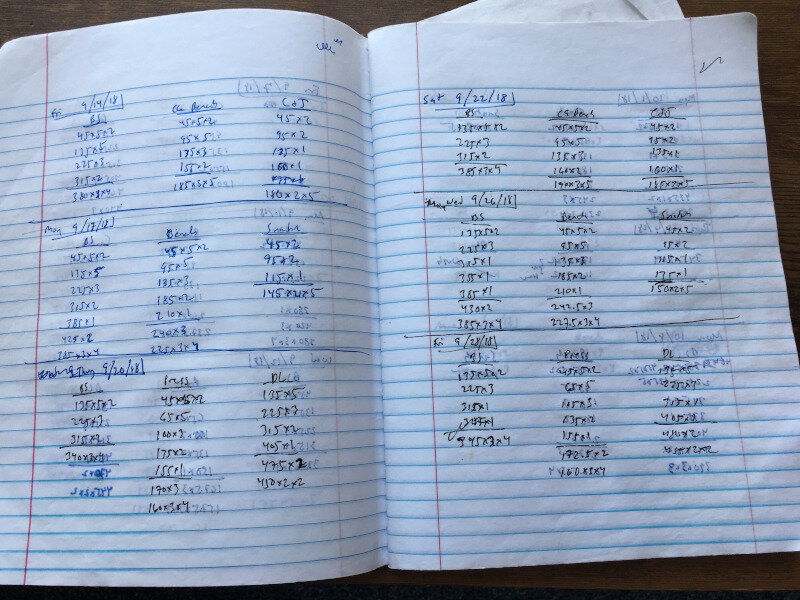
Separate your prescription from your warm-up with a short line, and with this done, your training log now looks like this:

Squat
3 x 5
—-------
45 x 5 x 2
95 x 5 x 1
135 x 3 x 1
185 x 2 x 1
215 x 1 x 1

Component #3: Work Sets
Now, it’s time to record the data for the work sets, which will be 235 lb x 5 reps x 3 sets. As a result, you have the following in your log:

Squat
3 x 5
—-------
45 x 5 x 2
95 x 5 x 1
135 x 3 x 1
185 x 2 x 1
215 x 1 x 1
—-------
235 x 5 x 3

Remember the golden rule of lifting notation, which is that the number of reps is always the second number written down - watch the included video if this is confusing.

Component #4: What You’re Going to Do Next
You squatted 235 lb today, and you successfully completed all of your work sets, so your next session will move to 240 lb, and thus, your training log looks like this now:

Squat
3 x 5
—-------
45 x 5 x 2
95 x 5 x 1
135 x 3 x 1
185 x 2 x 1
215 x 1 x 1
—-------
235 x 5 x 3
Next: 240

This would also be the time to note any upcoming programming changes. For example, perhaps you’re planning to squat 240 lb for a top set of 5 reps and then move on to 2 back-off sets of 5 reps - this “Next” section is the place to note it. Don’t walk out of the gym without writing this part down. Ever.

If you’re only performing one set at a given weight, the “1” at the end of the notation is optional. If you’d like to be a bit more concise, you can write it all out as shown below:

Squat
3 x 5
—-------
45 x 5 x 2
95 x 5
135 x 3
185 x 2
215 x 1
—-------
235 x 5 x 3
Next: 240

What Else?
You’ve got your prescription, your warm-ups, your work sets, and what you’re going to do next, so what else is there to write?

For starters, write down any cues that you want to use for your next session. “Midfoot,” “knees out,” “stay in your lean,” are all examples of cues that you might want to write down so that you remember what you’re working on the next time you lift.

You can also record how the training session went that day. Something like “235 felt pretty heavy today” is very satisfying to look back at 6 months from now when 235 lb is just an easy warm-up.

Lastly, it’s a good idea to keep a PR sheet. Set aside one page in your log on which to record your PRs - 1-rep PRs, 5-rep PRs, what you’ve done in training vs what you’ve done at a meet, etc. This is an excellent way to look back and measure your progress.

As always, we hope this helps you get stronger and live better. 

(Some links may be affiliate links. As an Amazon Associate, Testify earns from qualifying purchases.)

If you found this helpful, you’ll love our weekly email. It’s got useful videos, articles, and training tips just like the one in this article. Sign up below, and of course, if you don’t love it, you can unsubscribe at any time.


At Testify, we offer small group training, private coaching (in-person or remotely via Zoom), online coaching, and form checks. Would you like to get quality coaching from a Starting Strength Coach?

STOP Making These MISTAKES With Your Lifting Gear | Part 1: Errors #1-7

You're making some mistakes with your lifting gear, and you don't even know it. In Part 1 of this series, Starting Strength Coach Phil Meggers covers 7 errors (and how to fix them) that lifters make with their equipment.


At Testify, we offer small group training, private coaching (in-person or remotely via Zoom), online coaching, and form checks. Click the button below to get quality coaching from a Starting Strength Coach and start getting stronger TODAY.

Your Most Important Piece of Training Gear - Part 1 (Lifting Gear Series)

Today, we're going to talk about your most important piece of training equipment. It’s not your belt, shoes, or wrist wraps - it’s not even the barbell or the squat rack. Your belt, shoes, and wraps can be easily replaced, and people train on different squat racks and with different barbells all the time. The one item that cannot be replaced - the one thing that is specific to you - is your training log.

In Part 1 of this mini-series, we’re discussing why the training log is important and why you should keep one, and in Part 2, we’ll cover how to set one up and correctly use it.

Be sure to check out the included videos as they also cover some additional material not included in this article.

This is the sixth article in our “Lifting Gear” series. Click below to read the previous articles in the series:

Exercise vs Training
Your training log is important since it’s specific to you, but it’s important for a number of other reasons as well. For starters, the training log separates exercise from training.

There’s nothing wrong with exercising, and it is certainly much better than doing nothing at all. However, exercising is what you do when you want to get hot, you want to get sweaty, you want to get tired, and you want to feel like you’ve accomplished something. Training, on the other hand, is what you do when you actually want to accomplish something, and that’s what we’re focused on.

Your Training History
Your training log is also important because it contains your history. As a result, it of course contains your lifts, warm-ups, work sets, etc., but it holds more than that. It tells you how training went on a given day - you can write down notes about your training sessions, and I encourage you to do precisely this. Notes such as “Today was a great day,” “Today was terrible,” or “185 for work sets felt awfully heavy!” are all examples of what you might write in your log.

Remember - someday 185 lb will just be a warm-up weight, and on that day, it will be very satisfying to look back and remember when 185 lb was a challenging work weight.

Your Training Compass
Because you train, you have a program and a plan. You have goals, and because your training log contains your history - i.e., where you’ve been - it also functions as your compass and helps guide you in the direction you want to go.

The log works as a compass in two ways - first, before you leave the gym each day, plan your next session. You want to walk into the gym for your next workout knowing what you’re going to hit for your work sets, so write all of that down before leaving the gym.

Second, the log functions as a compass because you’re going to write down your goals: “I want to squat 315 lb,” “I’m going to get my first chin-up this year,” or “I want to bench 225 lb at my next meet” are all solid examples of goals to write in your training log. These help guide you, motivate you, and make the process much more gratifying when you achieve these milestones.

Your training log is important - it separates training from merely exercising, it contains your history, and it’s your compass as you go forward. Next, it’s time to learn how to keep a log, so in Part 2, we’ll cover precisely how to go about setting up and utilizing your training log. In the meantime, we hope this helps you get stronger and live better.

(Some links may be affiliate links. As an Amazon Associate, Testify earns from qualifying purchases.)

If you found this helpful, you’ll love our weekly email. It’s got useful videos, articles, and training tips just like the one in this article. Sign up below, and of course, if you don’t love it, you can unsubscribe at any time.


At Testify, we offer small group training, private coaching (in-person or remotely via Zoom), online coaching, and form checks. Would you like to get quality coaching from a Starting Strength Coach?

LIFTING SHOES: The Complete Guide to the Best and WORST Shoes! (Lifting Gear Series)

Lifting shoes - what they are, why you want to use them, what to look for, where to find them, and stick around to the end - why lifting in Chucks just might be the worst possible decision you could ever make.

Be sure to check out the included videos as they also cover some additional material not included in this article.

This is the fifth article in our “Lifting Gear” series. Click below to read the previous articles in the series:

What is a Lifting Shoe?
A lifting shoe is a shoe that has been - not surprisingly - specifically designed for lifting. To be clear, it’s not just a shoe that you happen to use for lifting. A lifting shoe has three distinguishing features, and it will look similar to the shoes in Figure 1.

The 3 Features of Lifting Shoes (and Why You Want to Wear Them)
The first distinguishing feature is the metatarsal strap(s). Every lifting shoe will have one or two velcro straps - these function to gather the foot together, provide support, and they act as a sort of belt for the foot.

Second, a lifting shoe will have a slightly elevated heel. Usually, the heel height is somewhere between a half inch and three quarters of an inch, and this small amount of heel elevation gets a bit more quad involved in the squat (and deadlift) and also helps with achieving depth in the squat. People often mistakenly focus on the heel as the most important feature, but that award goes to the next and final aspect of a lifting shoe.

Third - and this is the most important feature of a lifting shoe - a lifting shoe will have a rigid, non-compressible sole. When lifting heavy weights - whether squatting, pressing, deadlifting, snatching, cleaning, etc. - you want efficient force transfer between you and the floor. Specifically, you don’t want any loss of force transfer brought about by the variable amount of compressibility (i.e., “squishiness”) found in running shoes, basketball shoes, casual shoes, Chuck Taylors, etc.

figure 2: with 525 lb on his back, nathan appreciates the rigidity and support provided by his lifting shoes.

You can certainly train in non-lifting shoes, and doing so is far better than not lifting at all, but once you’ve trained in lifting shoes, lifting in anything else will feel like standing on pillows by comparison. Again, the non-compressible sole is the most important feature.

What to Look For When Shopping
Several major shoe makers as well as a few specialty companies manufacture and sell lifting shoes. To name a few, Nike, Adidas, Reebok, Inov-8, Do-Win, and VS Athletics all make quality lifting shoes.

You’ll usually need to purchase lifting shoes online as most local shoe and sporting goods stores do not have them. Do not trust a salesman’s recommendation . . . ever. He is simply recommending a shoe that he thinks would be good for lifting - he’s not recommending a lifting shoe, which is what you actually want.

You’re simply looking for a quality shoe that has been specifically designed for lifting, so it should possess the three features listed previously. With this in mind, below are a few links to get you started on your shopping:

Note: I would not recommend the Adidas Powerlift or any other lifting shoe with a compressed foam sole. The Powerlift is fairly popular due to its price point and is certainly still better than non-lifting shoe options, but the sole is not as rigid as we’d like, and quite simply, there are better options (such as its sibling, the Adidas Adipower 3).

For Crying Out Loud, Don’t Do This . . .
Chucks are the shoes for people who started to think about lifting shoes but never completed the thought.

Don’t lift in Chuck Taylors. Ever.

figure 3: Chucks are great for little kids and casual wear. They are pretty lousy for lifting.

Typically, those who lift in Chucks do so simply because they’ve seen others do so, which is understandable given the popularity of wearing Chucks for lifting in the 1980s and 1990s. There is rarely ever an actual rationale given for training in Chucks, but when there is, it usually goes something along the lines of “Since it doesn’t have an elevated heel, it’s lower to the ground than a lifting shoe, so I don’t have to pull my deadlifts as far when I wear Chucks.”

Under minimal scrutiny, however, this logic doesn’t hold up. The heel of a lifting shoe isn’t that big, but if you want to deadlift in a “flat” (i.e., a flat shoe with minimal elevation), then you want your feet as close to the ground as possible, and a Chuck is therefore a terrible option since it has a significant amount of padding and cushion between the foot and the ground.

Several companies make a deadlift-specific lifting shoe for those who prefer to pull in flats, and if you’re interested, you can check out the Sabo Deadlift Pro as an example of this sort of shoe (you’ll note that, like a typical lifting shoe, it too has a metatarsal strap). Even wrestling shoes or barefoot-style shoes such as the Inov-8 Bare XF 210 provide better low-profile options (though not as good as the Sabo) than a Chuck.

On one hand, if you’re looking for a flat, low-profile shoe for deadlifting, the Chuck puts a lot of squishy material between your foot and the floor, so it’s terrible in that sense. On the other hand, if you’re looking for a rigid, non-compressible sole, that same cushioning again makes the Chuck a lousy choice for lifting. If purchasing lifting shoes isn’t in someone’s budget at the moment, there are plenty of men’s dress shoes, work boots, and hiking shoes that all make better options than Chucks.

How Important Are Lifting Shoes?
After your training log, your lifting shoes are your second most important piece of personal training equipment, and if you purchase a quality pair, they should last for years. I’ve trained in my Nike Romaleos for 7 years and counting at this point (to be clear, I have the Romaleo 2, which Nike doesn’t make anymore, but here is the current version - the Romaleo 4), so they were easily worth the money.

While you can train in other shoes, (and again, doing so is far better than not lifting at all), there are some very compelling reasons to train in lifting shoes. Runners wear running shoes, basketball players wear basketball shoes, so lifters wearing lifting shoes shouldn’t surprise us.

Get yourself a quality pair of lifting shoes, and as always, we hope this helps you get stronger and live better.

(Some links may be affiliate links. As an Amazon Associate, Testify earns from qualifying purchases.)

If you found this helpful, you’ll love our weekly email. It’s got useful videos, articles, and training tips just like the one in this article. Sign up below, and of course, if you don’t love it, you can unsubscribe at any time.


At Testify, we offer small group training, private coaching (in-person or remotely via Zoom), online coaching, and form checks. Would you like to get quality coaching from a Starting Strength Coach?

I Forgot My Belt! (Simple Lifting Trick)

(A Blast from the Past article originally posted on 01/08/20)

Do you ever forget to put your belt on for your heavier sets? Perhaps you forget to wear your wrist wraps every once in a while?

Problem solved

These types of situations tend to occur more often when you’re a newer lifter, but even an experienced lifter can forget a belt or wrist wraps every now and then.

If you find yourself in one of the above situations from time to time, try this: hang your belt and wrist wraps on your barbell between sets.

By doing so, you’ll be forced to grab them before starting your next set, and the problem is solved. The next time you lift, give it a try. Hope this helps!

(Some links may be affiliate links. As an Amazon Associate, Testify earns from qualifying purchases.)

If you found this helpful, you’ll love our weekly email. It’s got useful videos, articles, and training tips just like the one in this article. Sign up below, and of course, if you don’t love it, you can unsubscribe at any time.


At Testify, we offer small group training, private coaching (in-person or remotely via Zoom), online coaching, and form checks. Would you like to get quality coaching from a Starting Strength Coach?

WRIST WRAPS: The Complete Guide and How NOT to Put Them On! (Lifting Gear Series)

Wrist wraps - what are they, why you’d want to use them, where to find them, what to look for when you’re shopping, how to use them, and perhaps most importantly - how not to use them. Be sure to check out the included videos as they also cover some additional material (and a shortcut or two) not included in this article.

This is the fourth article in our “Lifting Gear” series, so be sure to check back in the coming weeks for future articles in the series. Click below to read the previous articles in the series:

What is a Wrist Wrap?
Not surprisingly, a wrist wrap is a wrap that goes around your wrist. Brilliant, I know. Common lengths include 18” and 24”, and while you can find longer versions, these are probably the two most common lengths.

Figure 1: BAsic design of a wrist wrap (from left to right) - thumb loop, elastic body (including soft velcro portion), and velcro tab (i.e., the rough velcro “hook”).

The typical design (Figure 1) includes a thumb loop at one end, the elastic body of the wrap, and then a velcro closure system at the other end of the wrap.

Why Would You Want to Use Wrist Wraps?
A wrist wrap provides support for your wrist. It lends a measure of bracing to the wrist and acts as a kind of exoskeleton or belt for the wrist, which is very useful when your wrist is under compression as in a heavy press or bench press.

This bracing helps your wrist remain relatively straight and stay out of extreme extension (i.e., a very bent-back wrist position), a position that is inefficient for force transfer. As a result, the proper use of a wrist wrap helps you lift more efficiently.

Where Do You Get Wrist Wraps?
You can often find a few decent pairs at local sporting goods stores, but I generally recommend shopping for wrist wraps online as this allows you to select from a much wider range of wraps. Amazon, Rogue Fitness, and other online retailers provide a host of options, and many reputable manufacturers (e.g., Pioneer Fitness, Stoic, and SBD) sell directly from their websites as well, so that’s another option.

figure 2: 18” wraps from Harbinger (these are the wraps i use)

What to Get
We’ll provide a couple of reasonable options below, but for starters, I recommend either 18”-long wraps or 24”-long wraps. You can find 36” options, but most people will find wraps of this length to be rather unwieldy. Don’t get any wraps that are less than 18” long as such wraps provide very little support.

An 18” wrap is a good all-around option suitable for pressing, benching, and squatting (if you need to put your wrists in extension), and it can also be useful for the Olympic lifts, i.e., the snatch and clean-and-jerk.

figure 3: 24” wraps from pioneer

A 24” wrap is useful for pressing, benching, and squatting, but due to the added support and stiffness provided by the additional length of such a wrap, a 24” wrap is typically not as well suited to the Olympic lifts, where the wrists need to remain pretty mobile.

Some manufacturers provide different levels of stiffness (e.g., SBD) for their wraps, so be sure you read the product description completely before you purchase.

Below are a few solid options:

Which Lifts Benefit From Wrist Wraps?
A wrist wrap can be useful any time your wrist is supporting a load in compression, i.e., whenever you are pushing on something. As a result, pressing and benching benefit from the use of wraps as the weights get heavier. 

The snatch and jerk may both benefit from the use of wraps as both receiving positions involve supporting a heavy load overhead with the wrists in compression. However, note that although the jerk may benefit from wrist wraps, the clean - which immediately precedes the jerk - requires quite a bit of flexibility in the wrist to rack the bar on the shoulders. As a result, if you wear wraps for the clean-and-jerk, you may need to experiment with how tightly (and possibly where on your wrist) you wear the wraps so you can find a middle ground that provides support in the jerk while still allowing for mobility in the clean.

Of course, you’re welcome to use wrist wraps on lifts involving tension such as a row or a chin-up, but they won’t provide any benefit in these situations.

When Do You Wear Wrist Wraps?
Keep it simple. For starters, I recommend treating wrist wraps like your belt - put the wraps on for your last warm-up set, and then wear them for your work sets as well. Over time, you’ll figure out exactly when you want to start wearing them, and if you have a wrist that is a bit aggravated, you’ll probably start wearing a wrap a bit earlier than usual in your warm-ups.

How to Wear a Wrist Wrap
I strongly recommend watching the included video (above) as it’s easier to see and understand the process as opposed to reading and looking at a few pictures.

figure 4

  1. Place your thumb through the thumb loop. (Most wraps have a right and left wrap, so make sure you’re using the correct one - see Figure 4 for reference.)

  2. Apply a slight amount of tension as you lay the wrap across the back side of your wrist. Be sure the wrap covers the actual wrist itself - i.e., the hand and the forearm - and not just the forearm. A reasonable approach is to bias the initial position a bit more toward the hand and then wrap slightly “down” toward the forearm as you continue the process.

  3. Continue to wrap around the wrist and apply more tension once you’ve gone most of the way around.

  4. Secure the wrap using the velcro closure.

  5. Remove the thumb loop from your thumb before starting your set (the loop is only used to anchor the wrap when you’re putting it on).

figure 5: applying the wrist wrap and removing thumb loop

With practice, you’ll get a sense for how tight the wrap should be, but make no mistake - it should be quite snug. It should be tight enough that two criteria are satisfied; first, you should want to remove the wrap (or at least loosen it) between your sets, and second, it should make it difficult to bend your wrist. In other words, it needs to be tight enough to provide support, which brings us to . . .

What NOT to Do
The most common mistake with a wrist wrap is to wear the wrap too much (or entirely) on the forearm and not enough on the hand.

figure 6: demonstration of what not to do - this wrap is entirely on the forearm. don’t do this.

Remember - it’s a wrist wrap. Not a forearm warmer. The wrist is the joint connecting the forearm to the hand, so the wrap needs to cover both. If the wrap only covers the forearm (Figure 6), then - no matter how tight you get it - it won’t provide any support.

Can you move your wrist around easily with your wrap on? If you can, then it’s not tight enough, or more than likely, you’ve got it around your forearm and not your wrist.

Fix it, compadre.

As always, we hope this helps you get stronger and live better.

(Some links may be affiliate links. As an Amazon Associate, Testify earns from qualifying purchases.)

If you found this helpful, you’ll love our weekly email. It’s got useful videos, articles, and training tips just like the one in this article. Sign up below, and of course, if you don’t love it, you can unsubscribe at any time.


At Testify, we offer small group training, private coaching (in-person or remotely via Zoom), online coaching, and form checks. Would you like to get quality coaching from a Starting Strength Coach?