Antonio and the Deadlift

(This article is a Blast from the Past article originally posted on 12/02/18.)

Do you know about the Italian physician and anatomist Antonio Maria Valsalva (1666 - 1723)? Probably not, and that’s O.K., but every time you lift, you perform a maneuver - the Valsalva maneuver - that is named after him. To Valsalva is to hold your breath against a closed glottis, or perhaps more simply, to take a big breath and “bear down.”

You Valsalva instinctively when you are trying to push a stalled or stuck car, you Valsalva when you’re constipated and trying to poop, and fighter pilots Valsalva as part of their Anti-G Straining Maneuvers (AGSMs), which are performed to avoid passing out when subjected to high G-forces in the cockpit.

Now, let’s chat about the Valsalva maneuver and the deadlift.

You’ve been coached on the setup for the deadlift, so you’ve got the 5 steps down pat:

  • Stance - take a relatively narrow stance with your shins about 1” from the bar.

  • Grip - take a narrow grip on the bar (DO NOT MOVE THE BAR).

  • Shins - bend your knees to bring your shins into contact with the bar (DO NOT MOVE THE BAR).

  • Chest - squeeze your chest up to set your back in rigid extension (DO NOT MOVE THE BAR).

  • Pull - drag the bar up your legs.

jill correctly holds her valsalva at the top of her deadlift.

Most people will Valsalva right before (or during the process of) squeezing the chest up. Excellent. They will usually hold that Valsalva all the way up to the top of the lift - the lockout. Excellent again.

And right here - right at the top - this is where we tend to see a hiccup in the process. Some lifters (especially newer lifters) have a tendency to release their Valsalva at the top of the deadlift, i.e., they blow out their breath at the top. If you are one of these lifters - if you tend to release your breath at this point of the deadlift - there is only one thing to do.

Stop. That. Now.

james (left) and Loren (right) both know how important breath is when it comes to stability.

The Valsalva, the holding of your breath against a closed glottis and with tightly contracted abs - provides stability to the lift. Put simply, breath is stability, and stability is a wonderful thing to have when pulling heavy weights off the floor and setting them back down again.

So, if you tend to release your breath at the top of your deadlift, work on fixing it. Specifically, start by focusing on keeping your Valsalva while warming up the deadlift. The weight is lighter at this point, so you can spare some extra mental energy for this endeavor. Breath only when the bar is on the floor - not while loaded.

And be sure to thank Antonio the next time you complete a successful set of deadlifts.

(Some links may be affiliate links. As an Amazon Associate, Testify earns from qualifying purchases.)

If you found this helpful, you’ll love our weekly email. It’s got useful videos, articles, and training tips just like the one in this article. Sign up below, and of course, if you don’t love it, you can unsubscribe at any time.


At Testify, we offer small group training, private coaching (in-person or remotely via Zoom), online coaching, and form checks. Would you like to get quality coaching from a Starting Strength Coach?

Week 2021.12.13

This Week’s Conditioning

Option 1
Sled
Outdoors:
10-20 x 25 yds EMOM at a weight of your choice

Every minute, push the sled 25 yards, i.e., if pushing the sled takes 20 seconds, then you have 40 seconds to rest. Perform 10-20 rounds.

Indoors:
10-20 x 100 ft EMOM at a weight of your choice

Every minute, push the sled 100 feet, i.e., if pushing the sled takes 20 seconds, then you have 40 seconds to rest. Perform 10-20 rounds.

Compare to 2021.10.11

Option 2
Bike/row:
12 min TT
Score = distance

Compare to 2021.09.20.

Option 3
Outdoors:
5-10 rounds:
50 yd sled push (25 yd down-back)
50 yd farmer carry (25 yd down-back)
Rest 1 min

Indoors:
5-10 rounds:
100 ft sled push (50 ft down-back)
100 ft farmer carry (50 ft down-back)
Rest 1 min

Compare to 2021.08.23.

Option 4
10 x 50 ft farmer carry
Each carry is 25 ft down and 25 ft back and is for time. Rest 1 minute between carries.

Women: 97# per handle (80# of plates)
Men: 137# per handle (120# of plates)
(Note: Each handle weighs 17#.)

Compare to 2021.08.23.

4 Tips for a Better Bench Press

Let’s briefly cover a few tips to help you achieve a better, stronger bench press.

Tip #1: Grip
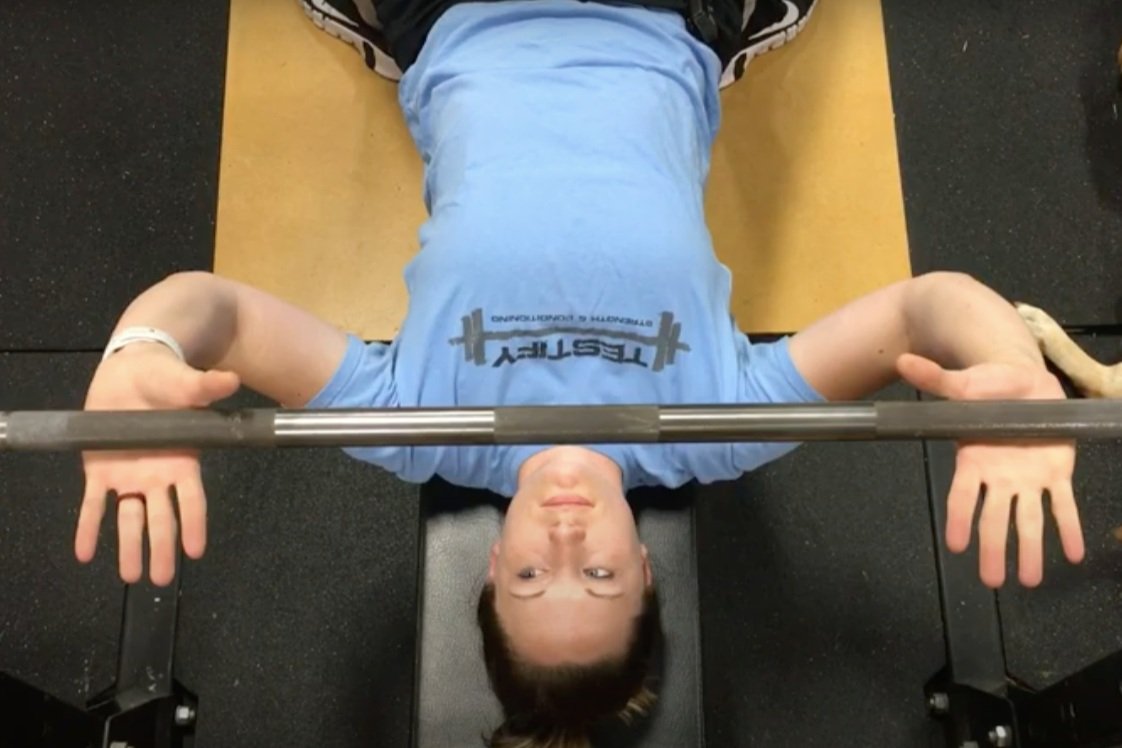
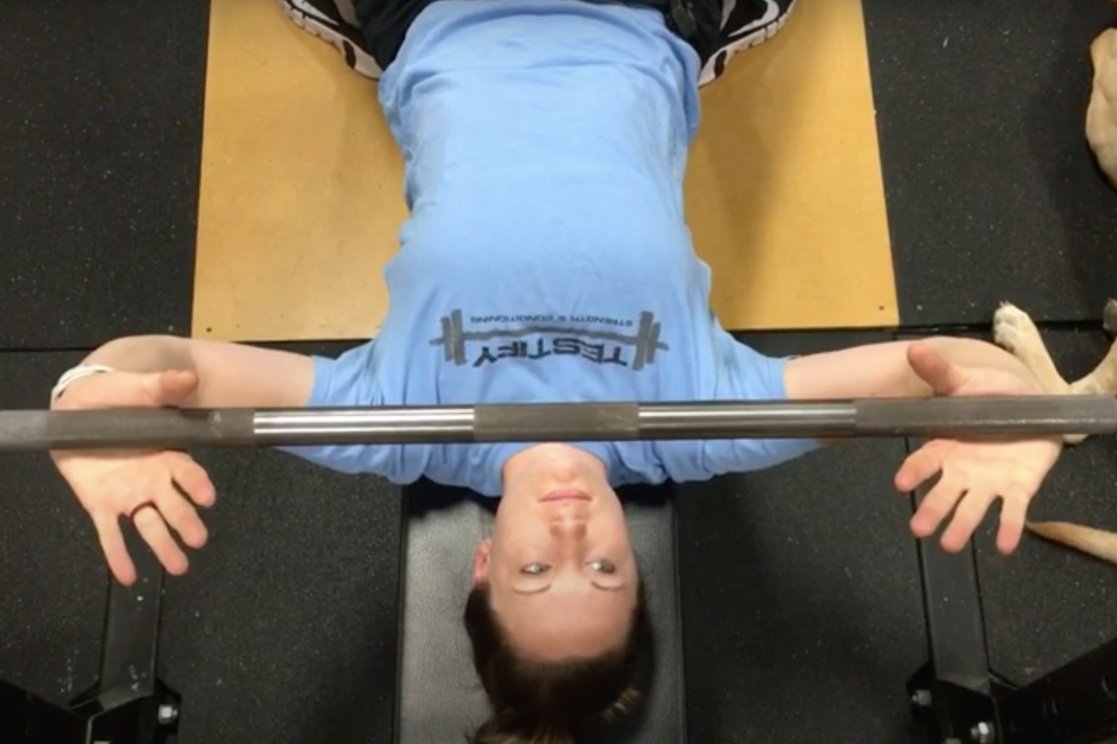
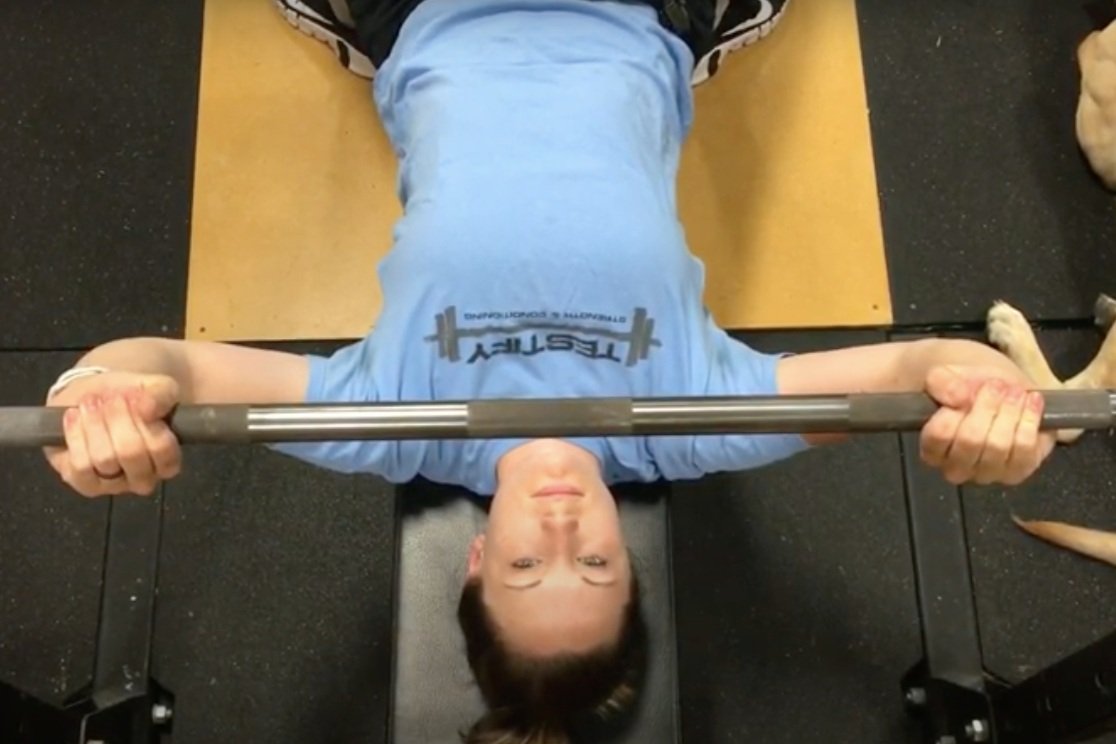
Take your grip so that the barbell rests on the base or heel of the palm, i.e., directly over the bones of the forearm. This is the best position for efficient force transfer between you and the bar.

To do this, simply pronate your hands slightly by internally rotating your arms a bit and then squeezing the bar tightly with your fingers. (scroll through the photos below for a demonstration)

Tip #2: Retract Your Shoulder Blades
For demonstrative purposes, imagine that you’re sitting upright (Figure 2), and there is a pen oriented vertically between your shoulder blades. You want to try and pull your shoulder blades back (i.e., retract your shoulder blades) so that the pen is pinched in place.

figure 2: at left, Becky demonstrates protracted shoulders (bad), and at right, becky demonstrates retracted shoulders (much better).

Now, simply perform that same motion (lying down, of course) when setting up for your bench press. Retract your shoulder blades before you unrack the bar, and then re-retract your shoulder blades after the unrack as well in case you lose a bit of shoulder positioning during the unracking process. Some people find the uprights of the rack useful to assist the process of setting the shoulders. Then, keep your shoulders retracted throughout your set (and re-retract them between reps if they get a bit out of position).

Tip #3: Leg Drive
Drive up the bench with your legs, i.e., use your legs to drive your body horizontally in the direction of your head (“up the bench”). The drive is horizontal, not vertical, so don’t lift your butt up off of the bench (the rep doesn’t count if you do that). Engage your legs before the start of each rep and drive up the bench throughout the entire movement (not just on the ascent).

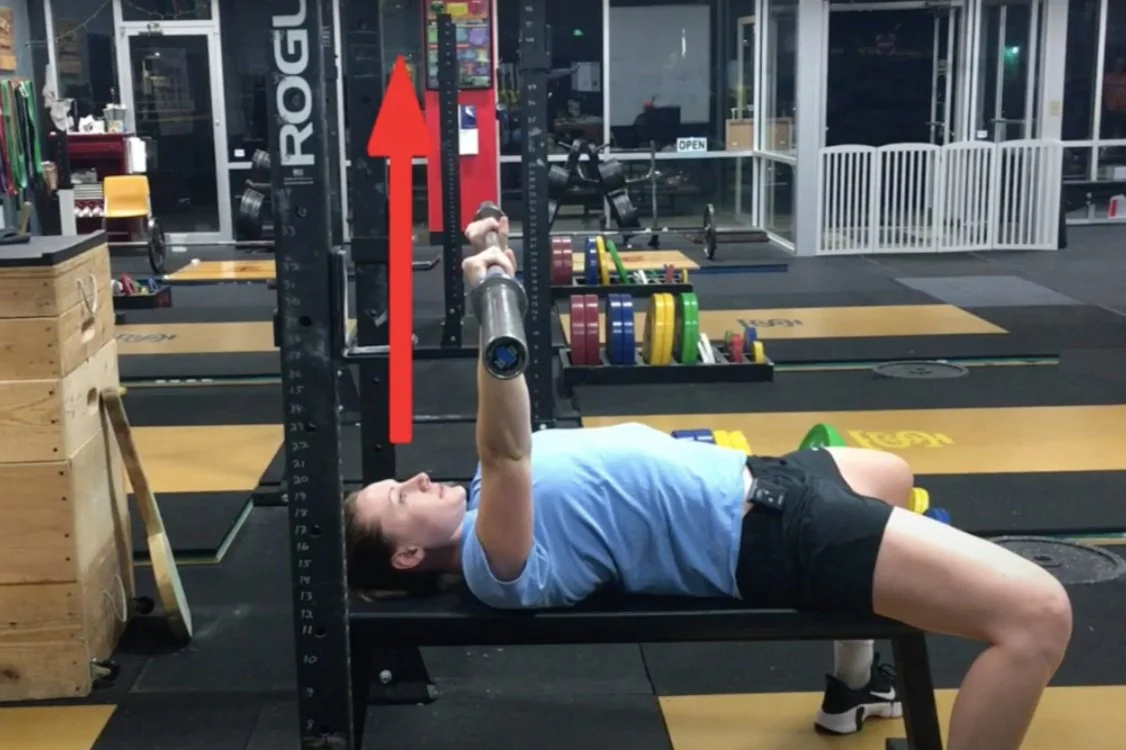
figure 2: Becky stares at the ceiling

Tip #4: Focal Point
Find a point directly above you on the ceiling and stare at that point throughout the entire set (Figure 2). Before you start your first rep, you can see the bar in your periphery, and the bar needs to finish in that same spot each time. A stationary reference point makes for a more consistent and efficient bar path, so we watch the immovable ceiling and not the moving bar.

We hope these tips help you get stronger and live better!

(Some links may be affiliate links. As an Amazon Associate, Testify earns from qualifying purchases.)
If you found this helpful, you’ll love our weekly email. It’s got useful videos, articles, and training tips just like the one in this article. Sign up below, and of course, if you don’t love it, you can unsubscribe at any time.


At Testify, we offer small group training, private coaching (in-person or remotely via Zoom), online coaching, and form checks. Would you like to get quality coaching from a Starting Strength Coach?

Week 2021.12.06

The annual Testify Christmas Classic was a great success this weekend, and we are immensely thankful to everyone who helped out! Loaders, referees, table officials, those who helped setup and tear down - we could not have hosted this meet without you all!

In addition, thank you to everyone who came out afterward (or stuck around!) for the annual Christmas party! We have the best members at Testify, and it was wonderful getting to hang out with you!

This Week’s Conditioning

Option 1
Sled
Outdoors:
10 rounds of:
Push sled 100 ft
Pull sled 100 ft (hand over hand)

Indoors:
20 rounds of:
Push sled 50 ft
Pull sled 50 ft (hand over hand)

Compare to 2021.10.04.

Option 2
Bike/row:
8 x 30 sec on/2:00 off

Score = least distance covered in any 30 second interval

Compare to 2021.09.13.

Option 3
8 rounds:
Outdoors:
4 tire flips
50 yd sled push (25 yd down-back)
Rest 1 minute

Indoors:
4 tire flips
100 ft sled push (50 ft down-back)
Rest 1 minute

Compare to 2021.08.16.

Option 4
Sandbag-over-bars
Set yoke at #33 for women or #35 for men.
1. 1 minute AMRAP
2. 5 rounds of 2 reps every 2 minutes (speed!)
3. 1 minute AMRAP

Weights
Female under 40 years
140 lbs and under: 75 lbs
140.1 lbs – 185 lbs: 100 lbs
185.1 lbs and over: 150 lbs

Female 40 years and over
140 lbs and under: 50 lbs
185 lbs and under: 75 lbs
185.1 lbs and over: 100 lbs

Male under 40 years
185 lbs and under: 150 lbs
185.1 lbs – 235 lbs: 200 lbs
235.1 lbs and over: 250 lbs

Male 40 years and over
185 lbs and under: 100 lbs
185.1 lbs – 235 lbs: 150 lbs
235.1 lbs and over: 200 lbs

Compare to 2021.08.16.

Fix Your Early Arm Bend on Your Cleans and Snatches!

Bent arms on a clean or snatch are a problem, so we’re going to try to solve this.

Figure 1: Becky reaches the top of the clean with straight arms, which is what we want.

In Figure 1, Becky demonstrates a clean with straight arms - which is what we want at this point in the lift.

In Figure 2, Becky demonstrates what we don’t want to see, which is a clean with an early arm pull (or “early arm bend”). In other words, we see her bend her arms before they are supposed to bend (for a real time view of this, watch the included video below).

Figure 2: Becky demonstrates an early arm pull (notice the bent elbows), which we don’t want.

The problem with bent arms is that they are deformable, i.e., they can change shape. If you’re Babe Ruth, and you want to hit a baseball, you want to do so with a bat - a rigid, non-deformable object. You don’t want to hit a baseball with a pool noodle because, no matter how strong or fast you are, you can’t effectively transfer that power into the baseball through a squishy pool noodle.

Likewise, during a clean (or snatch) you are trying to take all the power generated in your legs and hips and transfer it through your (hopefully) rigid spine and then down through your long, straight arms into the barbell. If your back isn’t rigid or if the arms aren’t straight, then those structures are deformable, which means they can absorb some of the power you’re trying to transmit to the bar. We don’t want this, so let’s cover some cues to solve this problem.

Cue #1: Long arms (or “straight arms”)
The first cue we’re going to use is the simplest approach. Just cue yourself “long arms” or “straight arms” (or even “straight elbows”). If this works, don’t make it any more complicated. The goal was long, straight arms, so we cued exactly that.

Cue #2: Flex your triceps (or “tight triceps”)
The job of the triceps is to extend (i.e., straighten) the elbow, so if you cue yourself to flex your triceps or tighten your triceps, then your elbows will be nice and straight, which is exactly what we’re looking for.

Cue #3: Shrug
If the first two cues don’t work, try cueing yourself to shrug at the top of the pull (i.e., the top part of the clean where your knees and hips are straight and you’re up on your toes - the top of the “jump”). A shrug is inherent to the movement anyway, but reminding yourself to aggressively shrug at the top of the clean will often solve a bent arm situation (very few people shrug with bent arms).

Cue #4: Leave it on the floor
This one requires some explanation before you actually try it out. The idea here is that you are endeavoring to have such long arms, straight arms that - even though you’re moving upward as you pull the bar off the floor - you are simultaneously trying to leave the bar on the floor. You’re trying to actively stretch your arms out so that, even while standing up, you’re trying to keep the bar down on the floor. It’s obviously an exaggerated mental picture - kind of a “go, go, Gadget-arms!” type of situation - but the cue itself shortens up to “leave it on the floor,” and it tends to work quite well.

We hope these cues help, and as always, we hope this helps you get stronger and live better!

(Some links may be affiliate links. As an Amazon Associate, Testify earns from qualifying purchases.)
If you found this helpful, you’ll love our weekly email. It’s got useful videos, articles, and training tips just like the one in this article. Sign up below, and of course, if you don’t love it, you can unsubscribe at any time.


At Testify, we offer small group training, private coaching (in-person or remotely via Zoom), online coaching, and form checks. Would you like to get quality coaching from a Starting Strength Coach?