Thinking About Competing? Here's Why You SHOULDN'T.

You’ve been squatting, pressing, deadlifting, and benching now for a few weeks - perhaps a few months, even. Maybe you’ve been snatching and clean-and-jerking, too, you crazy cat. Then it happens - you hear about an upcoming meet that’s a few months away, and for the briefest of moments, you actually think that you might sign up for it. “It could be kinda fun,” you find yourself thinking.

But then you mentally pull back a bit. You think, “I think I’ll do a meet at some point - maybe when my squat gets up to Random Weight. Yeah. That sounds good. When I can squat Random Weight and deadlift Other Random Weight, then I’ll sign up.”

Stop. Stop it right now. Your problem is - somewhere along the line - you became an adult. If you were still in kindergarten, your folks would toss you in youth soccer/basketball/volleyball, and two weeks later, you’d play your first game.

Thank goodness. If kindergartners played sports the way we adults often treat lifting, the poor kids would never get to play a game. Instead, they practice for a few weeks, then they play some games . . . and they have a blast.

You will too. Don’t wait until you feel ready. If you wait for that particular ethereal sensation, you’ll never sign up. Once your squat gets up to Random Weight, you’ll tell yourself, “Well, that wasn’t all that impressive, but I’ll sign up when my squat gets to The Next Goal.” This type of thinking runs on forever, and in the meantime, you’ll be missing out on a lot of fun.

Because that’s what happens when you do a meet. Fun. After someone’s first meet, I always hear something like, “That was so much fun! I’ll definitely do another one.” You don’t do your first meet to break world records - you do it to have fun and get some experience, and you then have some numbers to try and beat for your next competition.

If you’re thinking about competing . . . don’t. Not “Don’t compete” but “Don’t think about competing.” Just do it.

The time to compete is Now. Not later. Stop thinking about it. Just sign up. That meet is still a few months off, anyway, so you’ve got plenty of time to train. But sign up today. You won’t regret it.

As a side note, if you’re still reading at this point, you’re definitely thinking about signing up for a meet, so click here to head over to our events page and check out our veritable smorgasbord of upcoming events. You’ll have a blast no matter which one you choose.

As always, we hope this helps you get stronger and live better.

-Phil

PS: Whenever you want even more Testify in your life, here are some free resources:

  • Book a free intro and strategy session with us HERE.

  • Pick up a free copy of Testify’s Squat Guide: 12 Tips to Improve Your Squat Now HERE.

  • Get our free weekly email - containing useful videos, articles, and training tips - HERE.

  • Follow Testify on Instagram HERE.

  • Subscribe to Testify’s YouTube channel HERE.

(Some links may be affiliate links. As an Amazon Associate, Testify earns from qualifying purchases.)

At Testify, we offer small group training, private coaching (in-person or remotely via Zoom), online coaching, and form checks. Interested in getting stronger, looking better, and having more energy?

Barbell Sports

IMG_6792.JPG

(A Blast from the Past article originally posted on 11/20/18.)

“What’s the deal with all of these lifting sports? I can’t keep them straight!”

No worries - let’s take a quick look at the three major sports of the barbell world.

  • Powerlifting: This is the sport of the back squat, bench press, and the deadlift. Each lifter gets 3 attempts on the squat, 3 attempts on the bench press, and 3 attempts on the deadlift. Take your best attempt from each lift, add them together, and you have what is known as your total.

  • Strengthlifting: This is the sport of the back squat, the press, and the deadlift. It is similar to powerlifting, but there are several notable differences:

    • The press (i.e., overhead press) is contested, not the bench press.

    • The deadlift is conventional, which means your hands go outside of your legs. This is how we teach the deadlift anyway, so it’s not unusual to you, but at powerlifting meets, a beast known as the sumo deadlift often makes an appearance (wherein the stance is very wide and the grip is fairly narrow - inside the stance).

    • The judges simply tell you whether or not the lift counted, whereas in powerlifting, the judges are a bit more involved.

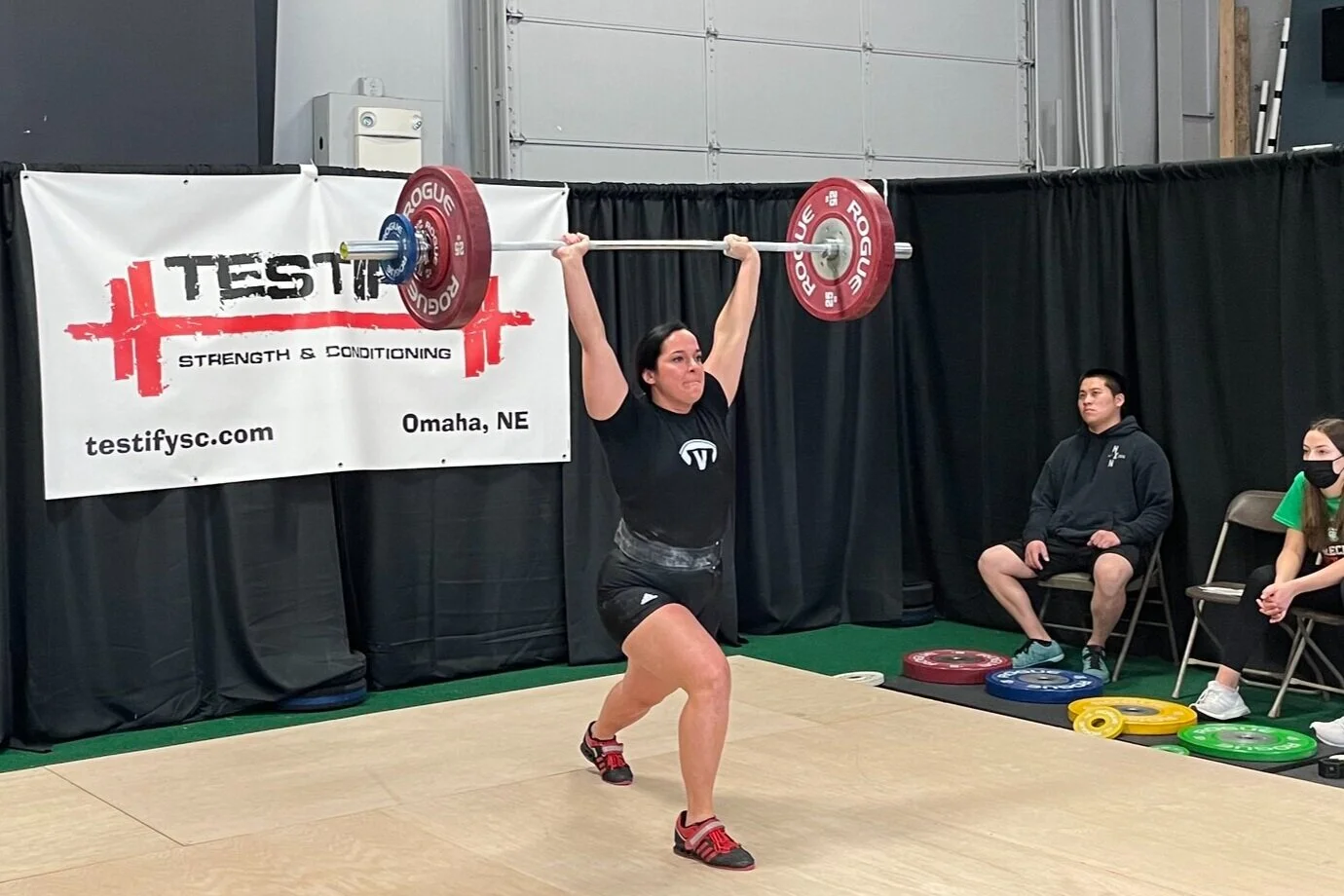
  • Weightlifting: This is the sport of the snatch and the clean-and-jerk. Like the other two sports, each lifter gets 3 attempts on each of the lifts, and once again, we add the best successful lifts together to get a total.

    • Weightlifting is also known as “olympic weightlifting” or simply “olympic lifting.”

    • If you’ve ever watched lifting during the Summer Olympics, this is the sport you witnessed.

Weightlifting Meets: Placing and Tiebreakers

IMG_6451.jpg

A lifter’s place (i.e., 1st place, 2nd place, etc.) at a weightlifting meet is determined by the total, i.e., the sum of the lifter’s heaviest successful snatch and the lifter’s heaviest successful clean-and-jerk. Since two lifters can have the same total, let’s look at the IWF (International Weightlifting Federation) rules for determining place and - specifically - breaking any ties that may occur. Let’s look at the rules in order of application (the official IWF phrasing is given in bold) using our sample lifters Bob and Joe.

Rule #1: Best result - highest first: if identical, then:
This one is pretty simple - if Bob’s total is 170 kg and Joe’s total is 165 kg, then Bob wins because his total is higher. If they both total 170 kg, then we move on to Rule #2 . . .

Rule #2: Best Clean & Jerk result – lowest first; if identical, then:
Bob and Joe both total 170 kg in keeping with the example above. Bob’s best clean-and-jerk is 90 kg while Joe’s best clean-and-jerk is 100 kg. Bob’s clean-and-jerk is lower than Joe’s, so Bob wins.

This logic can seem a bit strange at first, and we’ll address it after going through the rest of the rules. However, if their best clean-and-jerks are both 90 kg, then we move on to Rule #3 . . .

Rule #3: Best Clean & Jerk result’s attempt number – least number of attempt first; if identical, then:
As stated above, Bob and Joe’s best clean-and-jerks are both 90 kg. Bob hit 90 kg on his 2nd attempt while Joe hit 90 kg on his 3rd attempt. Bob’s attempt number is lower than Joe’s (i.e., 2 is lower than 3), so Bob wins.

Again, if the logic seems strange, don’t worry - we’ll get to it in a moment. On the other hand, if they both clean-and-jerked 90 kg (i.e., their best) on their 2nd attempt, then we move on to Rule #4 . . .

Rule #4: Previous attempt(s) – least number of attempt first; if identical, then:
Now, it gets slightly more complicated. Again, in our example, Bob and Joe both clean-and-jerked 90 kg (i.e., their best) on their 2nd attempt. Bob attempted 85 kg on his first attempt while Joe opened at 86 kg. Since 85 is less than 86, Bob wins.

If they both hit 90 kg for their best clean-and-jerk on their second attempts, and they both opened at 85 kg, then we move on to Rule #5 . . .

Rule #5: Lot number – lowest first.
Last time - we promise. Bob and Joe both clean-and-jerk 90 kg (i.e., their best) on their 2nd attempt, and they both opened at 85 kg. Bob’s lot number is 15 while Joe’s lot number is 23. Bob’s lot number is lower than Joe’s, so Bob wins.

These rules can seem pretty convoluted, but if you’re actually watching the meet, it’s pretty simple. Rule #1 is fairly obvious - whoever lifts the most wins. After that, when it comes to the tiebreaker rules (i.e., Rules #2-5), the basic idea is that whoever hits that 170 kg total first - in time - wins. For example, if Bob establishes his 170 kg total at 1:30 p.m., and Joe establishes his 170 kg total at 1:40 p.m., Bob wins since he got to 170 kg earlier in the day than Joe did. Seriously - that’s it.

In the example for Rule #2, Bob’s total is cemented in place when he hits 90 kg for his last successful lift. That means his total is 170 kg before Joe ever steps on the platform to attempt 100 kg. In other words, Bob is rewarded for having staked his claim to 170 kg first - Joe could have gone for 101 kg to total 171 kg, but he instead went for the tie at 170 kg, and since Bob got there first, he wins.

All of the other rules that follow are simply worded to guarantee that this same concept applies in all situations, which can require some serious thought when considering how the order of lifting is determined in weightlifting (for more on that, read this article).

So simply remember this - in the case of a tie, if you hit the total first, you win.

(Some links may be affiliate links. As an Amazon Associate, Testify earns from qualifying purchases.)

If you found this helpful, you’ll love our weekly email. It’s got useful videos, articles, and training tips just like the one in this article. Sign up below, and of course, if you don’t love it, you can unsubscribe at any time.

At Testify, we offer small group training, private coaching (in-person or remotely via Zoom), online coaching, and form checks. Would you like to get quality coaching from a Starting Strength Coach?