The Hook Grip - Some Clarifications

(A Blast from the Past article originally posted on 11/18/19)

We discussed the rationale for using the hook grip quite a while ago, and in light of a few recent conversations, I thought a few clarifications might be in order.

When do I use the hook grip?
Use the hook grip when pulling a barbell from the floor. Specifically, use the hook grip for cleans, snatches, and heavy deadlifts. I suppose you could use the hook grip for rows as well, but I’d probably recommend that if your row requires a hook grip, simply use straps instead and save your thumbs for your other pulls from the floor.

Don’t hook your presses, i.e., don’t use the hook grip anytime you are pushing a barbell - this includes bench presses (regular, close grip, incline, etc.), presses, jerks, and push presses. This is just silly, and your friends will give you no end of grief for doing so. You only perform the hook grip when the wrist is in tension, and this means that you only hook pulling movements, movements where - if the weight is heavy enough - your grip might fail.

Does the hook grip always hurt?
Yes. And no.

Yes, because of course there is quite a bit of pressure on your thumb, and at first, you will find this to be quite . . . uncomfortable. If you feel like screaming like a 3-year-old at the end of your deadlift work set, congratulations, you’re among friends.

No, because eventually you won’t notice the discomfort nearly as much as you do at first, and more importantly, you will stop caring. You are a lifter, and you’ll have more important things to complain about, such as having to unload all the plates from your massively heavy deadlift that you just pulled . . . because you used the hook grip. Everyone who uses it adapts to it, and you are not a special snowflake. Yes, you.

Why does the hook grip work so well?
When taking a normal, double-overhand grip (i.e., without the hook) on the bar, you’ll notice that you have four fingers on one side of the bar and only one finger (your thumb) on the other side of the bar. It is the thumb that fails you when the load gets heavy - it leads a lonely existence on that side of the bar, and it doesn’t have any friends to help.

The hook grip remedies this situation by allowing the other fingers (primarily the middle finger) to help the thumb maintain its purchase on the bar. I suspect that the thumb also starts to fail in the non-hooked grip due to the angle of attack it has on the bar - note its somewhat “from-the-side” approach to gripping the bar compared to the other fingers’ perpendicular approach to the bar - but I haven’t given this enough thought just yet. Nonetheless, suspicions abound.

Now you know, and in time, I think you’ll be hooked on this grip.

(Some links may be affiliate links. As an Amazon Associate, Testify earns from qualifying purchases.)

If you found this helpful, you’ll love our weekly email. It’s got useful videos, articles, and training tips just like the one in this article. Sign up below, and of course, if you don’t love it, you can unsubscribe at any time.


At Testify, we offer small group training, private coaching (in-person or remotely via Zoom), online coaching, and form checks. Would you like to get quality coaching from a Starting Strength Coach?

Week 2022.05.09

We hosted the annual Testify Barbell MAYhem this past weekend, and it was a great success! We are immensely thankful to everyone who helped out - loaders, referees, table officials, those who helped setup and tear down - we could not have hosted this meet without you all!

This Week’s Conditioning

Option 1
Sled
Outdoors:
10 rounds of:
Push sled 100 ft
Pull sled 100 ft (hand over hand)

Indoors:
20 rounds of:
Push sled 50 ft
Pull sled 50 ft (hand over hand)

Compare to 2022.03.07.

Option 2
Bike/row:
4 x 3 minutes

Rest 3 minutes between each round. Score = lowest distance.

Compare to 2022.02.14.

Option 3
1. Work up to a heavy single on the axle clean-and-press (i.e., ground to overhead).
2. 5 x 100 ft Zercher carry (50 ft down-back). Add weight each round. Rest as needed.

Compare to 2022.01.17.

Option 4
Outdoors:
5 rounds:
15 cal row
50 yd sled push, 100#/50#

Indoors:
5 rounds:
15 cal row
100 ft sled push, 250#/125#

Push sled slow for recovery. Score is slowest row.

Compare to 2022.01.17.


At Testify, we offer small group training, private coaching (in-person or remotely via Zoom), online coaching, and form checks. Would you like to get quality coaching from a Starting Strength Coach?

The Bench Press: You're Forgetting to Do This - Part 2

When benching, you know you’re supposed to retract your shoulder blades, push with your legs, and drive that bar up and back to its original starting position, but you’re still forgetting one thing . . .

Get your grip right.

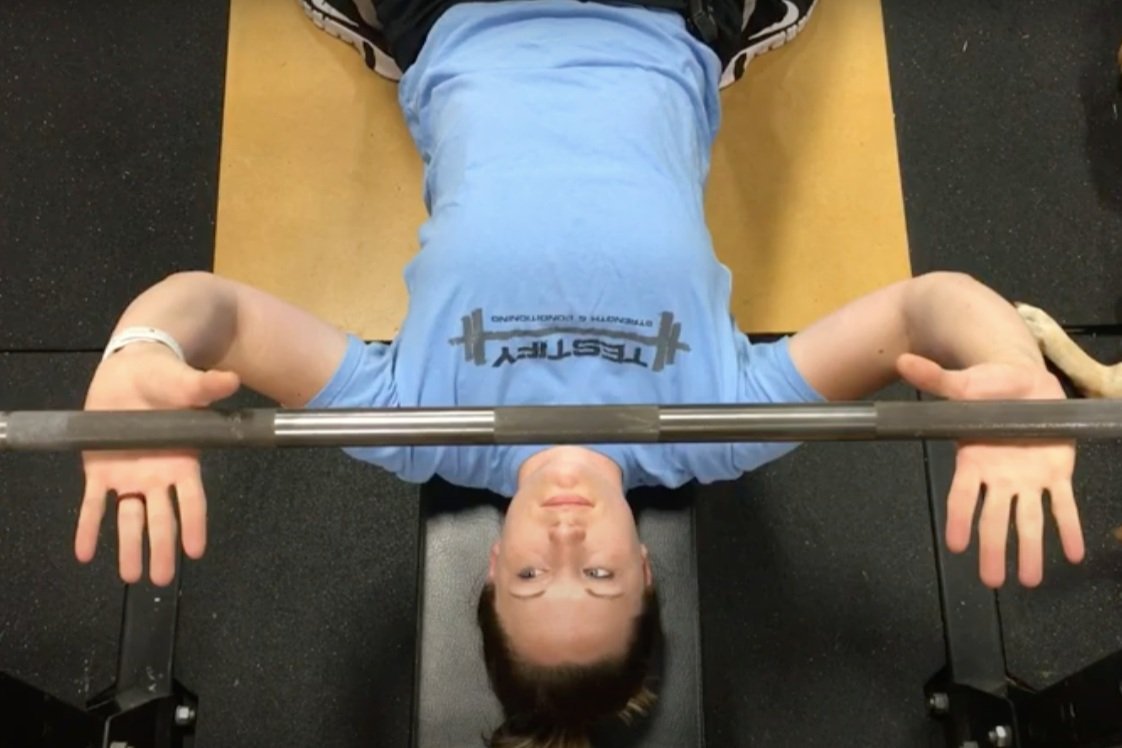
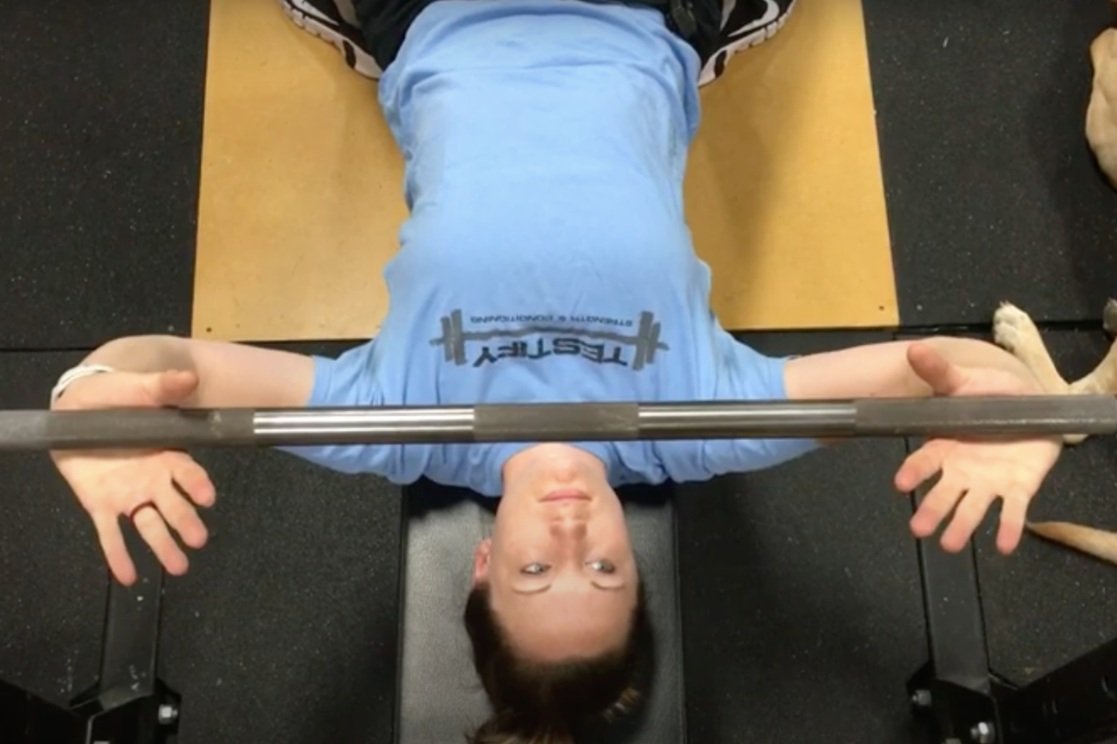
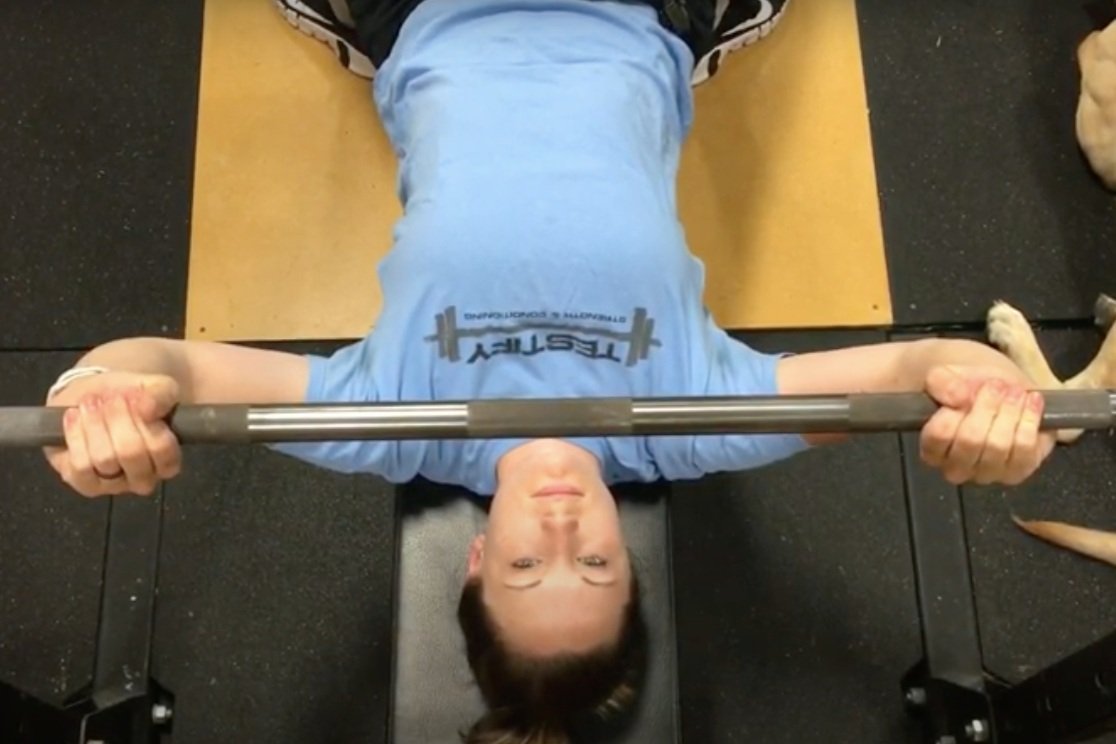
When taking your grip for the bench, you want the barbell to rest on the base or heel of the palm, i.e., directly over the bones of your forearm. This ensures that you have efficient force transfer between you and the bar, which is rather important when trying to move heavy weights. On the other hand, having the bar back toward your fingers causes your wrists to be in full extension (i.e., bent backwards), which is a flimsy and weak position for them to be in when trying to support a heavy load.

To achieve the correct grip, pronate your hands slightly by internally rotating your arms a bit and then squeezing the bar tightly with your fingers (scroll through the photos below for a demonstration).

If this doesn’t quite make sense, you can use the “diamond grip” approach described in this short article.

As always, we hope this helps you get stronger and live better.

(Some links may be affiliate links. As an Amazon Associate, Testify earns from qualifying purchases.)
If you found this helpful, you’ll love our weekly email. It’s got useful videos, articles, and training tips just like the one in this article. Sign up below, and of course, if you don’t love it, you can unsubscribe at any time.


At Testify, we offer small group training, private coaching (in-person or remotely via Zoom), online coaching, and form checks. Would you like to get quality coaching from a Starting Strength Coach?

Week 2022.05.02

Reminder: Please note that the gym will be closed for training this Saturday, 05/07/22, as we are hosting the annual Testify Barbell MAYhem weightlifting meet.

This Week’s Conditioning

Option 1
Sled Pyramid – 4, 5, or 6 tiers
Go up and down a 4, 5, or 6 tier “sled pyramid” – rest as needed. The distance for each round is 80 m indoors (a down-back on the 40m course) or 200 ft outdoors (2 down-backs on the 50 ft course). Rest as needed.

For example, Bob does the following (4 tiers):
Round 1: Empty sled
Round 2: 25#
Round 3: 50#
Round 4: 75#
Round 5: 50#
Round 6: 25#
Round 7: Empty sled

Compare to 2022.02.28.

Option 2
Bike/row:
5 min on
4 min off
4 min on
3 min off
3 min on
2 min off
2 min on
1 min off
1 min on

Record distance for each interval and add for total distance.

Compare to 2022.02.07.

Option 3
Outdoors:
8 rounds:
4 tire flips
50 yd sled push (25 yd down-back)
Rest 1 minute

Indoors:
8 rounds:
4 tire flips
100 ft sled push (50 ft down-back)
Rest 1 minute

Compare to 2022.01.10.

Option 4
5 rounds:
4 tire flips
8 sledgehammer strikes
6 pull-ups
10 push-ups

Pull-ups and push-ups can be modified – talk to the coaches for options.

Compare to 2022.01.10.


At Testify, we offer small group training, private coaching (in-person or remotely via Zoom), online coaching, and form checks. Would you like to get quality coaching from a Starting Strength Coach?

The Squat: You're Going to Do This Wrong

You’ve read the Blue Book, you’ve watched the videos, the bar is sitting in that nice, low bar position, and you’ve correctly performed the Valsalva maneuver - you’re ready to squat.

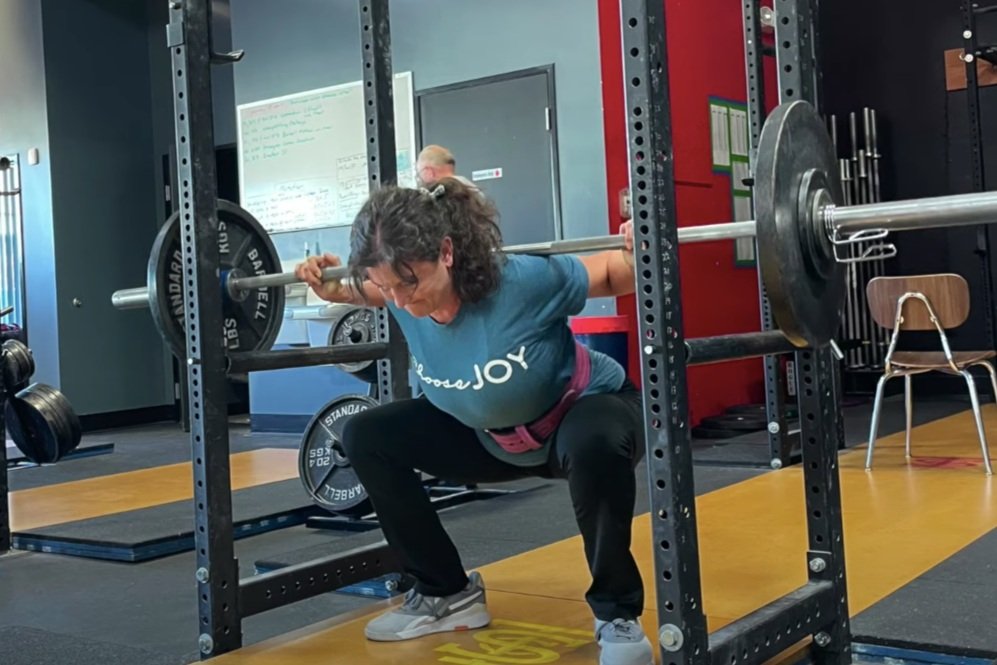
Don’t be like this fool.

If you’re new to squatting, though, you’re about to do something wrong . . .

You’re going to try and maintain a vertical back angle as you descend - in other words, you’re going to try and keep your torso as upright as possible.

Everyone does this at first, so don’t worry, you’re not a mutant, but we need to correct it, and we want to correct it right away. Simply tell yourself, “Point my chest at the floor” as you start your descent. In other words, reach back with your butt and lean over as you squat (check out the video below for a demonstration).

It’s easy to accidentally confuse “vertical back” with “straight back.” We want a straight, rigid back, but we don’t want a vertical back while squatting.

This . . . is much better.

Of course, it will be vertical at the beginning and the end of the movement (when we’re standing up), but your squat will be stronger and more efficient if your point your chest at the floor as you start your descent and then keep it pointed at the floor as you drive back up out of the bottom as well.

As always, we hope this helps you get stronger and live better.

(Some links may be affiliate links. As an Amazon Associate, Testify earns from qualifying purchases.)
This . . . is also much better.

If you found this helpful, you’ll love our weekly email. It’s got useful videos, articles, and training tips just like the one in this article. Sign up below, and of course, if you don’t love it, you can unsubscribe at any time.


At Testify, we offer small group training, private coaching (in-person or remotely via Zoom), online coaching, and form checks. Would you like to get quality coaching from a Starting Strength Coach?

Week 2022.04.25

This Week’s Conditioning

Option 1
Sled
Outdoors:
10 rounds of:
Push sled 100 ft
Pull sled 100 ft (hand over hand)

Indoors:
20 rounds of:
Push sled 50 ft
Pull sled 50 ft (hand over hand)

Compare to 2022.02.21.

Option 2
Bike/row:
4 x 3 minutes

Rest 3 minutes between each round. Score = lowest distance.

Compare to 2022.01.31.

Option 3
5-10 rounds:
50 ft yoke carry
50 ft yoke push
100 ft sandbag carry and S.O.B. (sandbag-over-bar)

Perform 1 round every 2-3 minutes.

Compare to 2022.01.03.

Option 4
Row/Tire 10 min ladder:
2 cal row
2 tire flips
4 cal row
4 tire flips
6 cal row
6 tire flips

Climb the ladder as high as possible in 10 minutes.

Compare to 2022.01.03.


At Testify, we offer small group training, private coaching (in-person or remotely via Zoom), online coaching, and form checks. Would you like to get quality coaching from a Starting Strength Coach?